
Márta Kucsora
Temporary Equilibrium
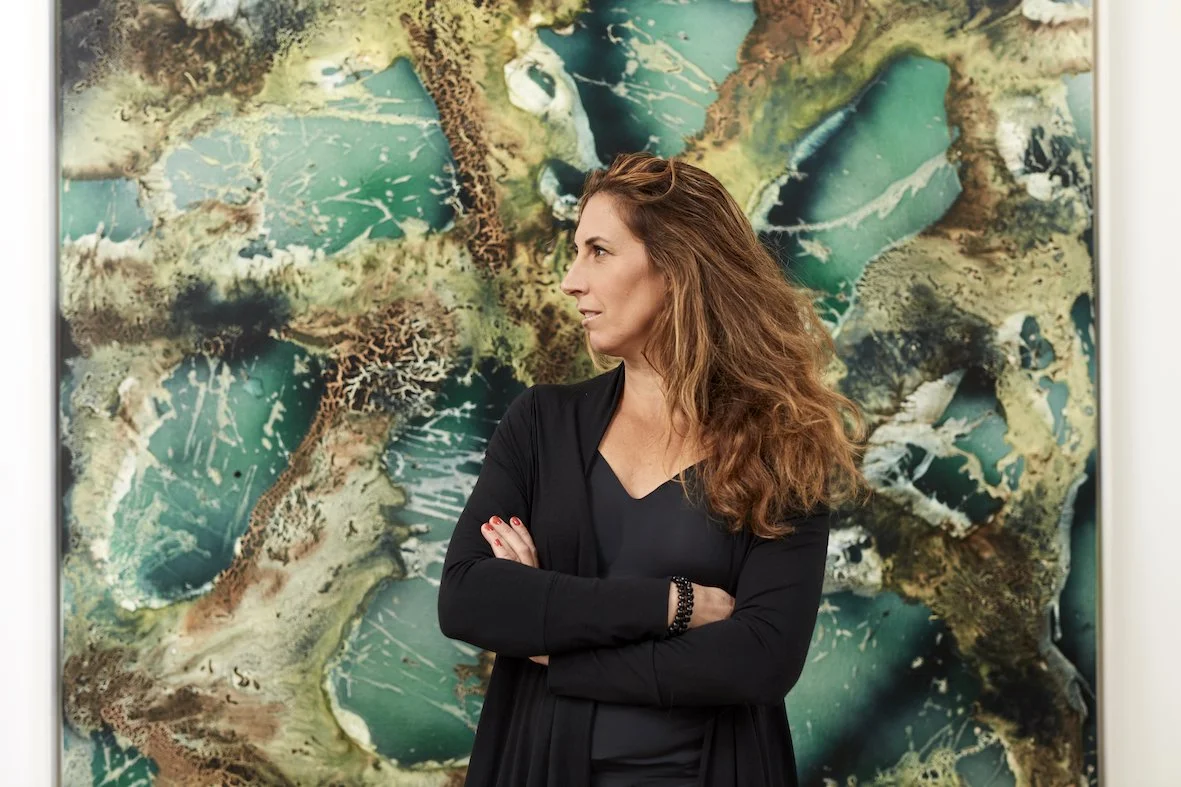
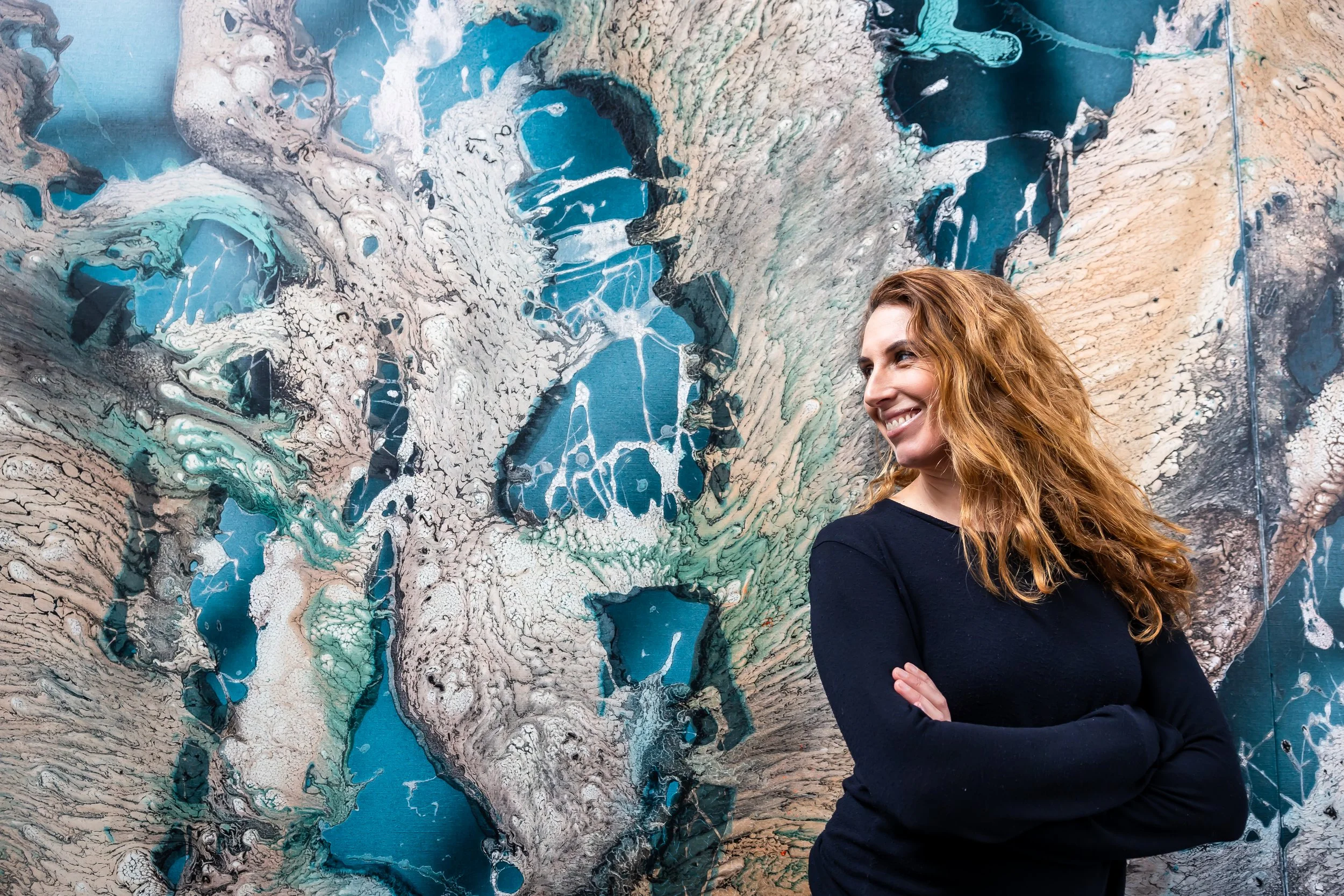
Márta Kucsora - Credits David Biro
“Temporary Equilibrium”
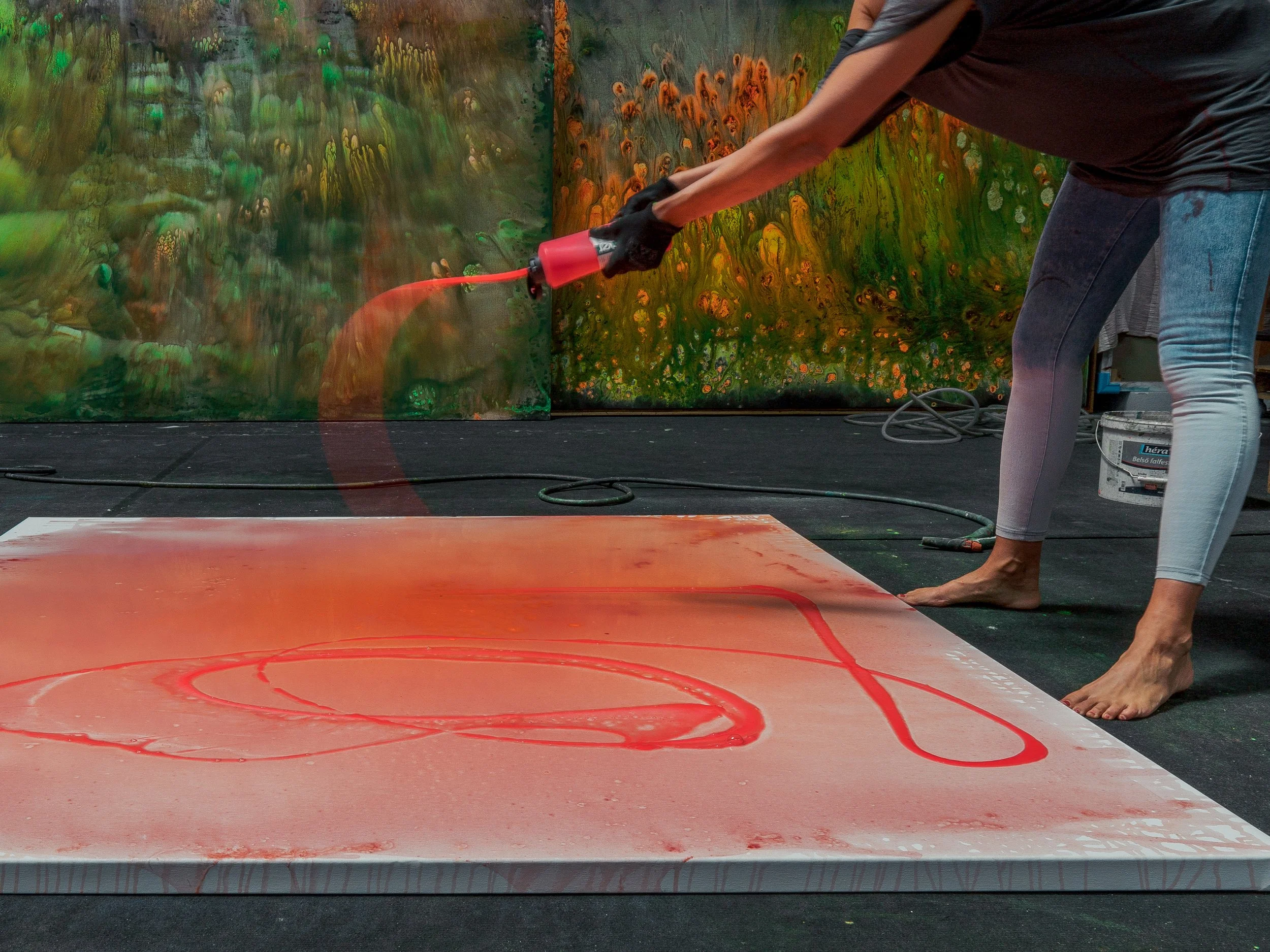
She tilts the canvas
and waits for gravity to answer.
Color argues with surface,
movement slows — not ending,
just listening.
For a moment
matter agrees with itself.
Temporary equilibrium:
a quiet truce
between the hand
and what cannot be held.
-
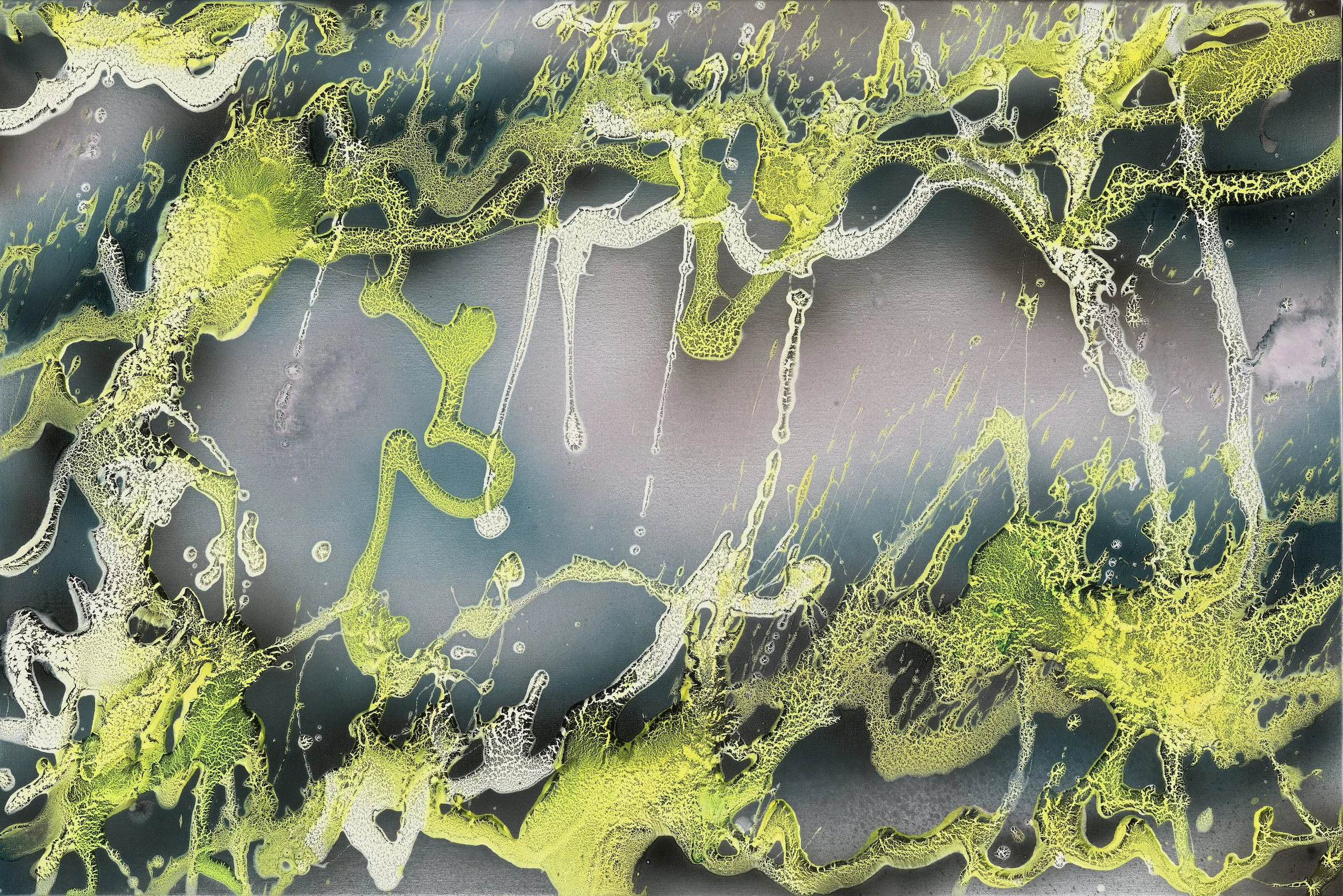
“Painting, for me, is intimate, confidential, and deeply personal. It is a parallel reality in which the body, material, and environment are entangled - where attention itself participates in what the work becomes.”
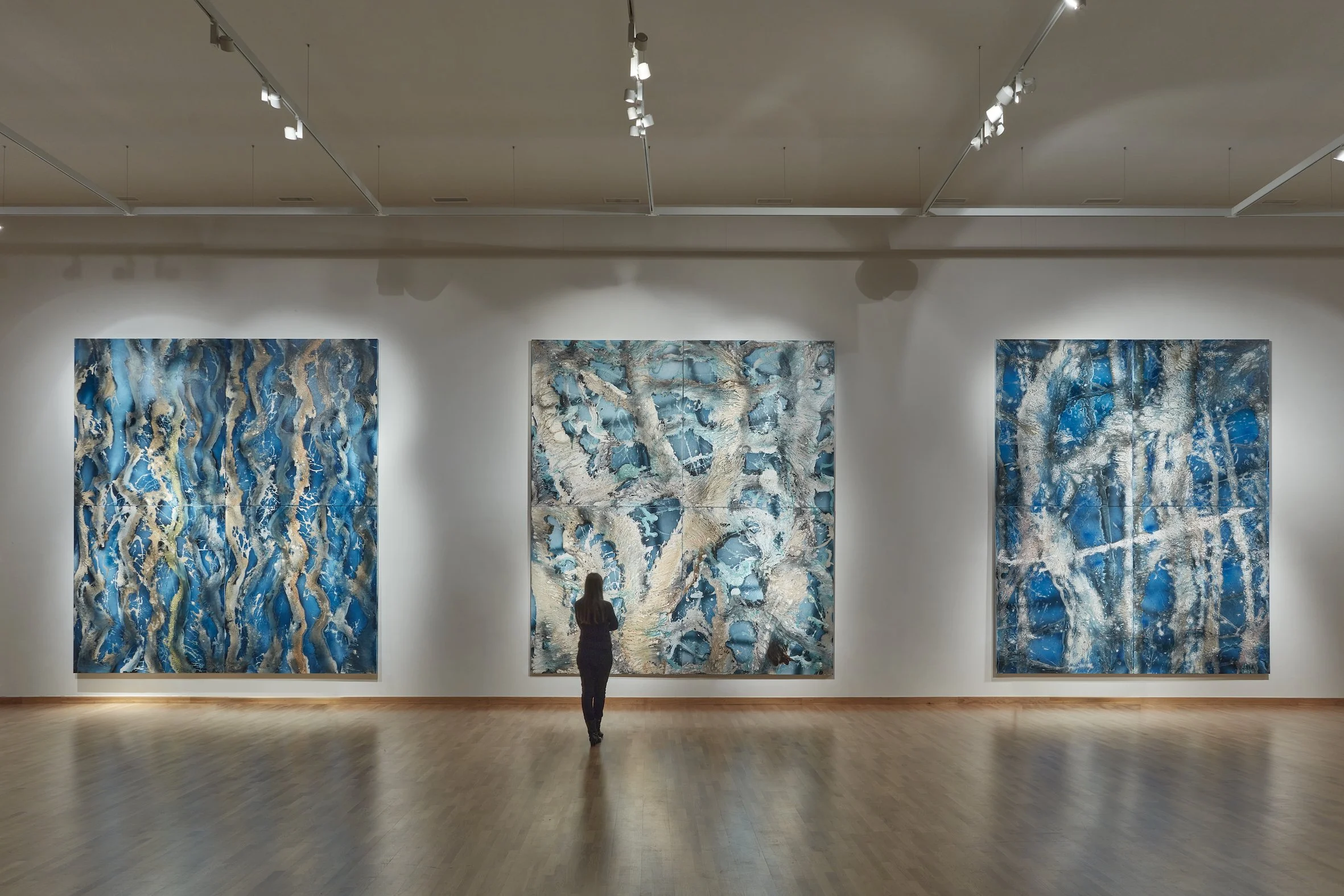
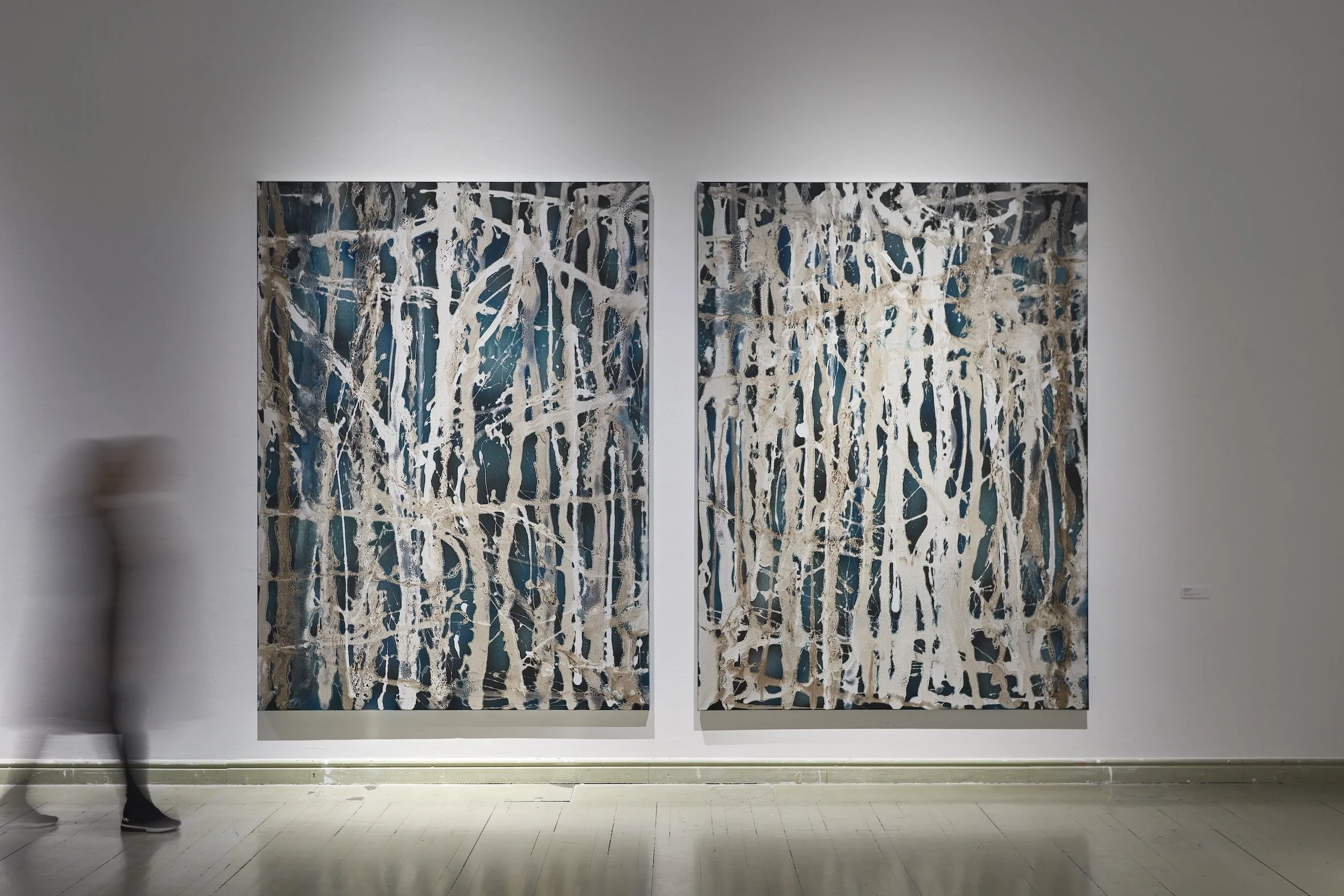
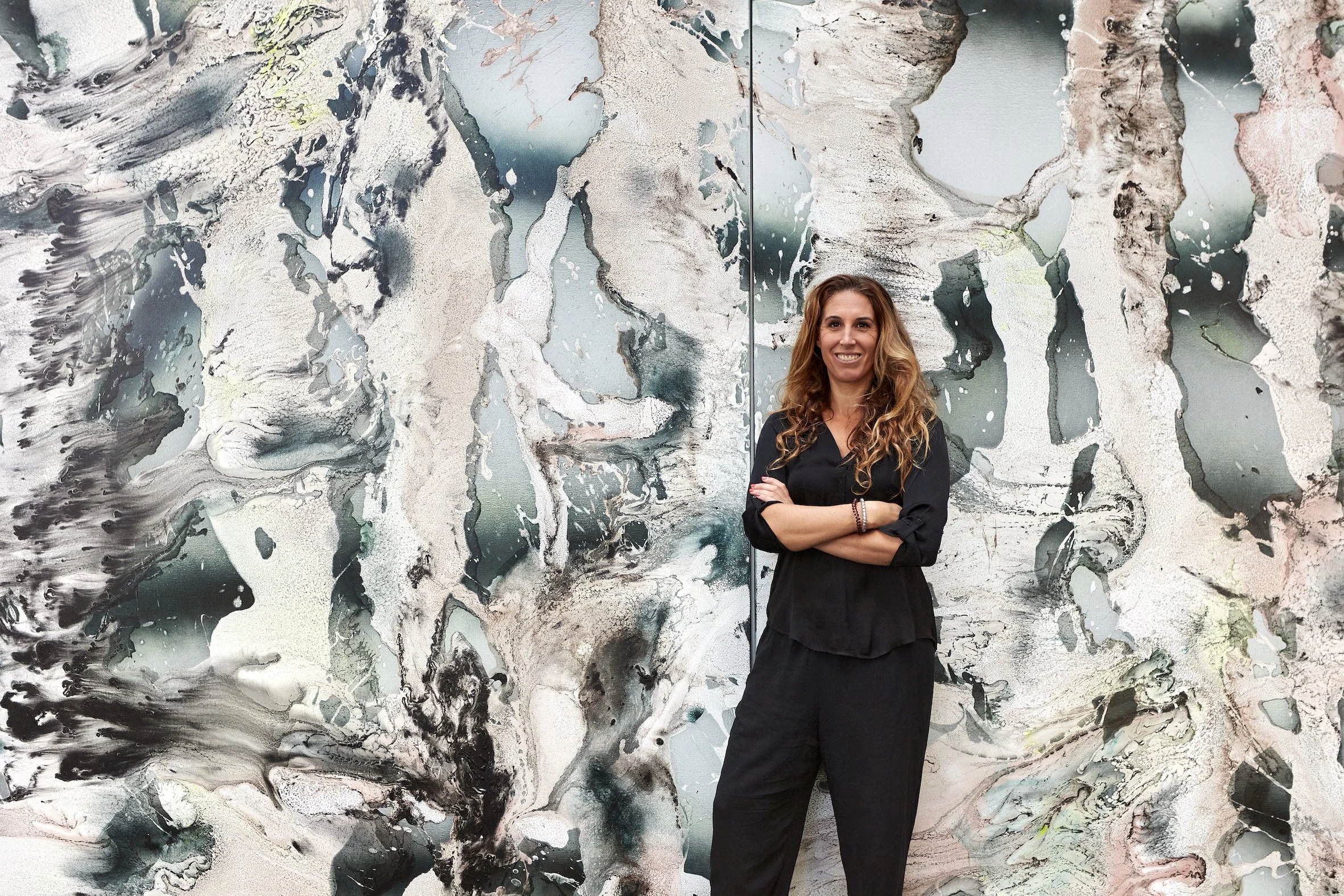
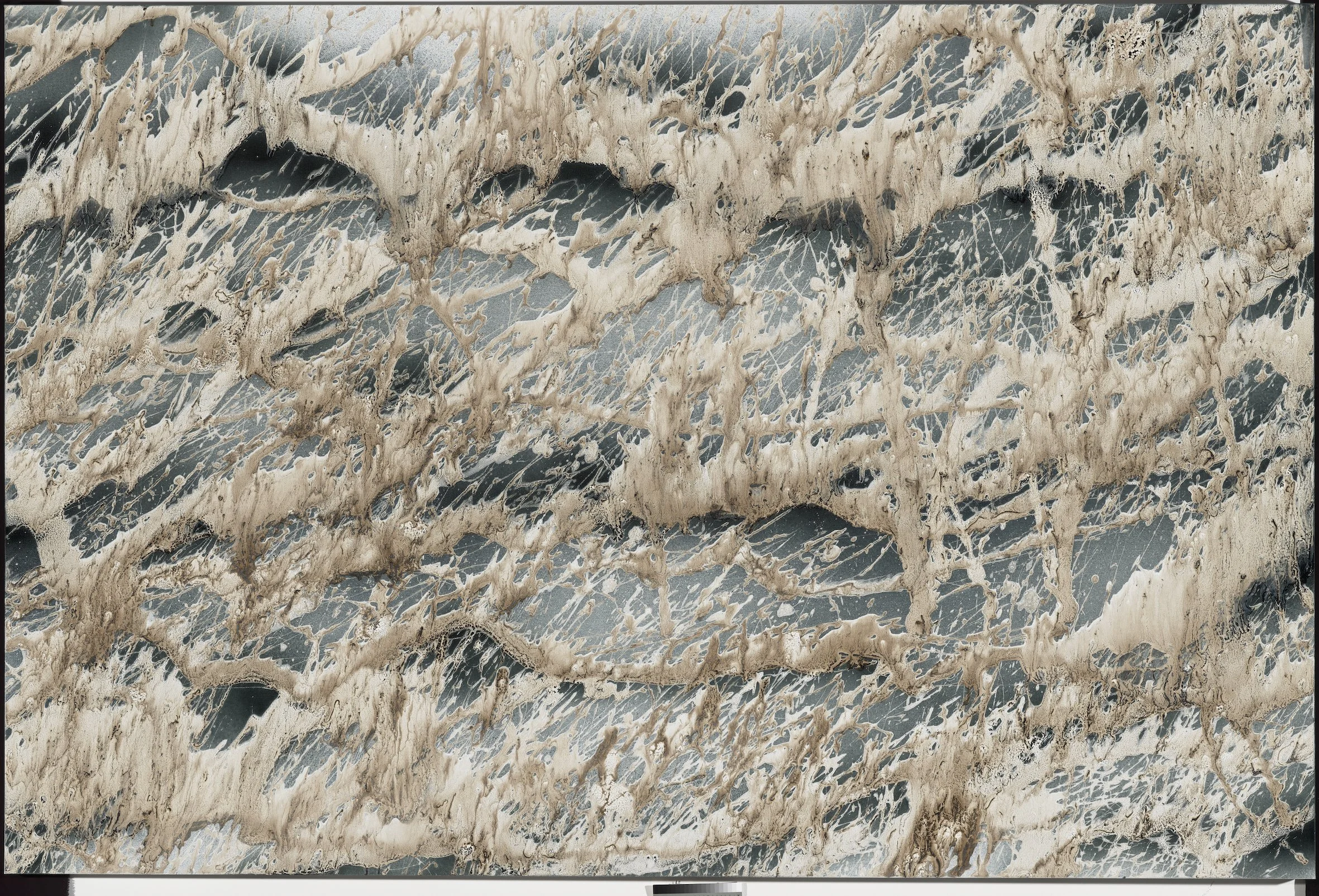
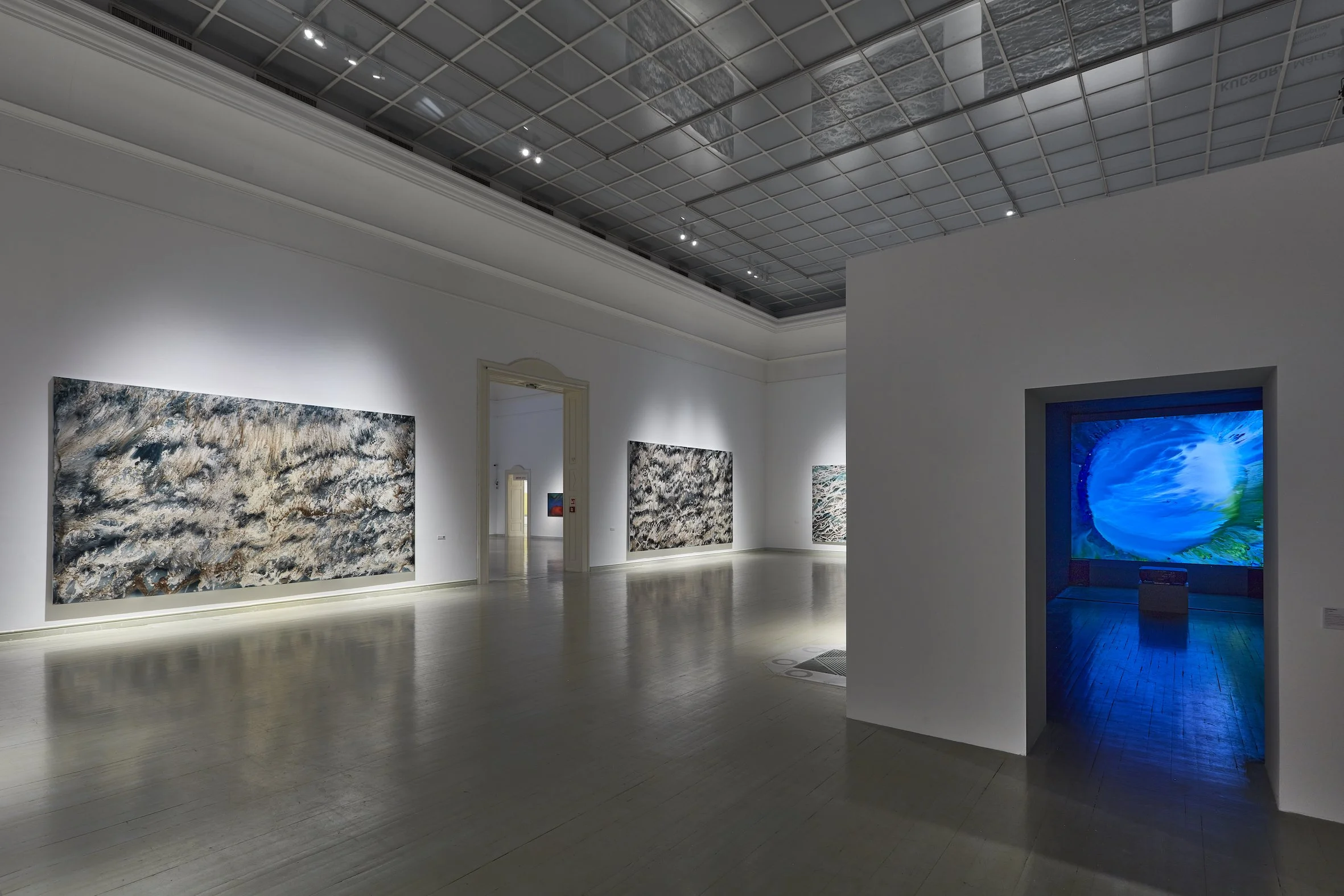
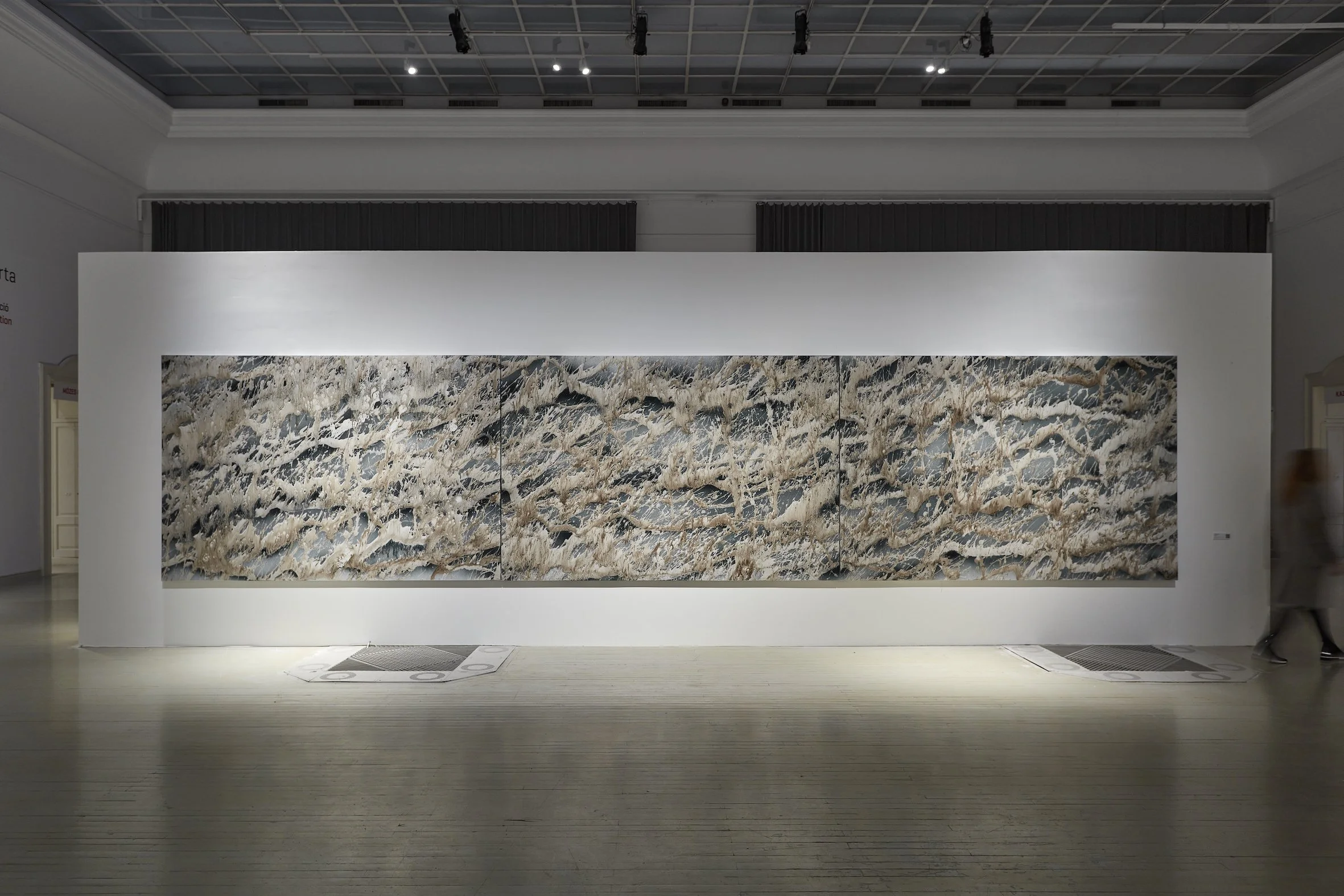
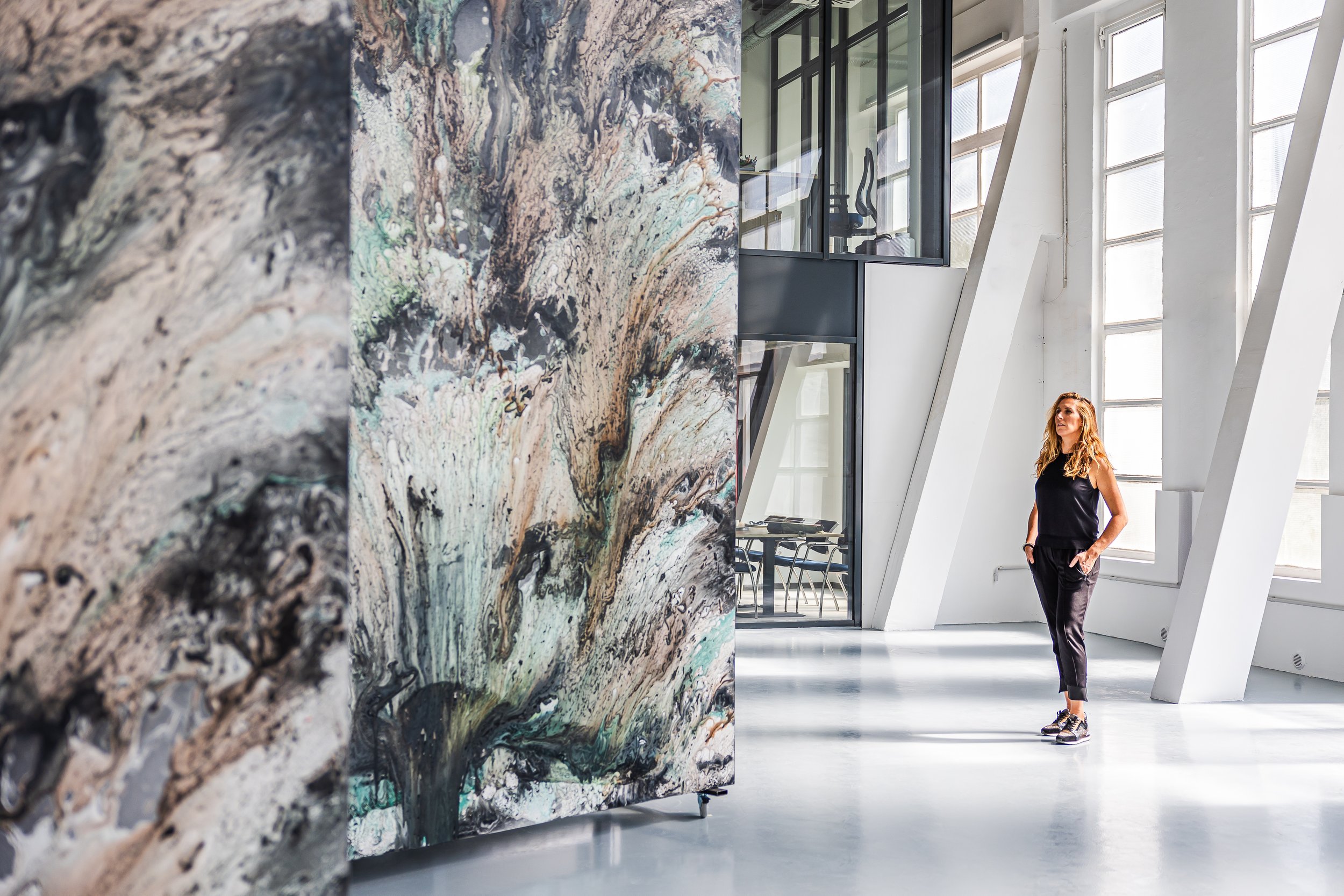
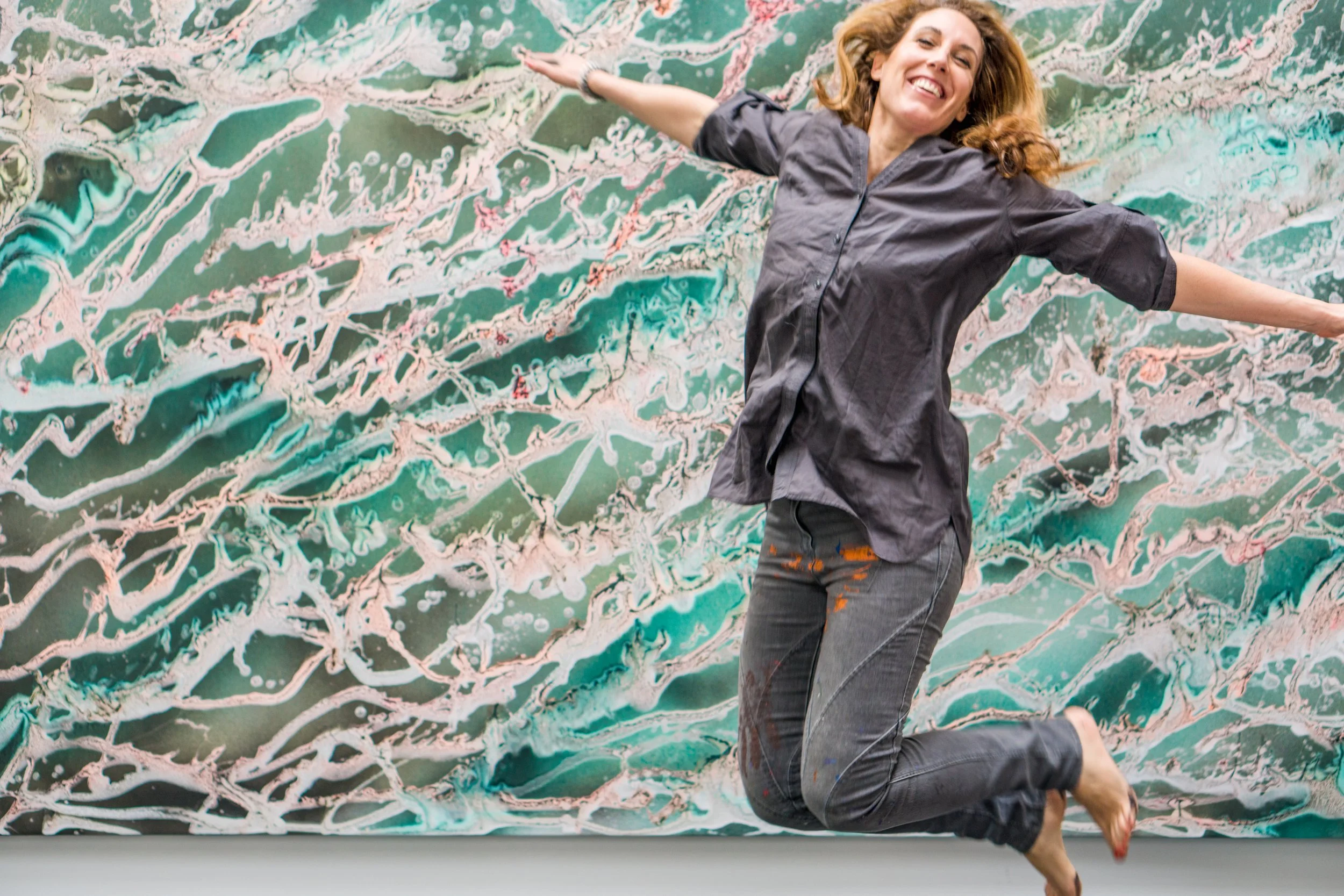
1979, Budapest, Hungary. Lives and works in Budapest In a unique updating of brushless painting, Márta Kucsora lends a visual voice to the tension between macro and micro, movement and stasis, process and result. By creating fluid visual realms whose poetic motion reflects on the constant change inherent in all things, she questions the positionality of the beholder who is challenged to situate themself in a constant conversation with the unraveling patterns of colour. Of distinct visual impact, Kucsora‘s compositions echo with a creative force that originates within the intriguing chromatic designs she orchestrates. Diverse materials that either attract or repel each other constitute the point of departure for her groundbreaking technique where vibrant matter substitutes the artist‘s controlling hand. In an extension of the Abstract Expressionists‘ gesture, pastes, lacquers and paints of varied density and viscosity enter an impassioned struggle upon their encounter on canvas, thereby resulting in patterns of rhythmic depth as the colour pigments condense and crystallise into animated formations. In pioneering this process, Márta Kucsora strikes a delicate balance between chance and control, ultimately embracing a state of self-abandonment in the expressive moment of matter taking over and choosing its own viable part. Active, conscious planning and preparation thus yield to the force of the uncontrolled which lends the compositions their remarkably autonomous nature. Unrestrained in their directed cadence, Márta Kucsora‘s works live by a raw, kinetic energy. Her canvases are constantly evolving, shifting, transforming sites, freed from any methodical rein as they solely abide by their very own laws. Never meant to illustrate or represent, the works refer to nothing but themselves, recalling the moment of their creation in an actualisation through the embodied viewer who by virtue of their physicality becomes the extension of the dynamic flow and motion of the colours. A sensation that lingers on in the beholding subject — repercussions of a sublime primordial force which in Márta Kucsora‘s paintings becomes viscerally tangible. Márta Kucsora has had solo and group exhibitions at CoBrA Gallery (Shanghai), Kahan Art Space Buda/Eva Kahan Foundation (Budapest), Postmasters (Rome), Képes Institute (Éger), The Concept Space (London), Pumpwerk (Siegburg), Langyuan Station (Beijiing), Kálmán Makláry Fine Arts (Budapest), Alludo Room Gallery (Milan), 21C Museum (Cincinnati, Ohio), Museum of Young Art (Vienna), Galeria Urbana (Las Águitas), Art Factory Gallery (Miami Beach). Her works can be found in various public and private collections, including among others Die Mobiliar Art Collection (Bern), MNB Hungarian National Bank (Budapest), Deji Art Museum (Nanjing), 21C Museum (Louisville), ERSTE BANK (Budapest), Ruhrverband (Essen, Germany), Erftverband (Bergheim), Sammlung Lupa (Klettgau, Germany), Képes Institute (Éger, Hungary).
-
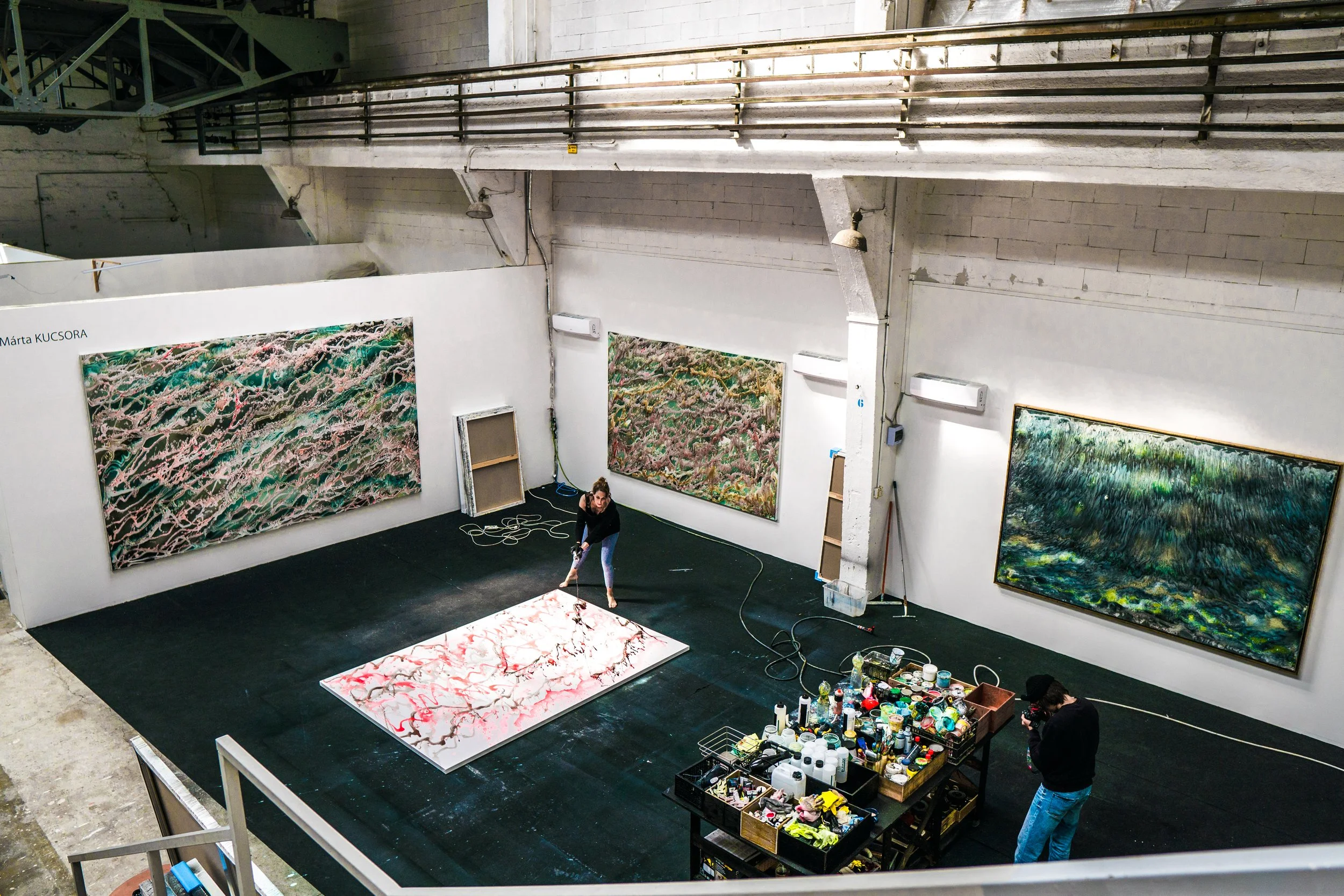
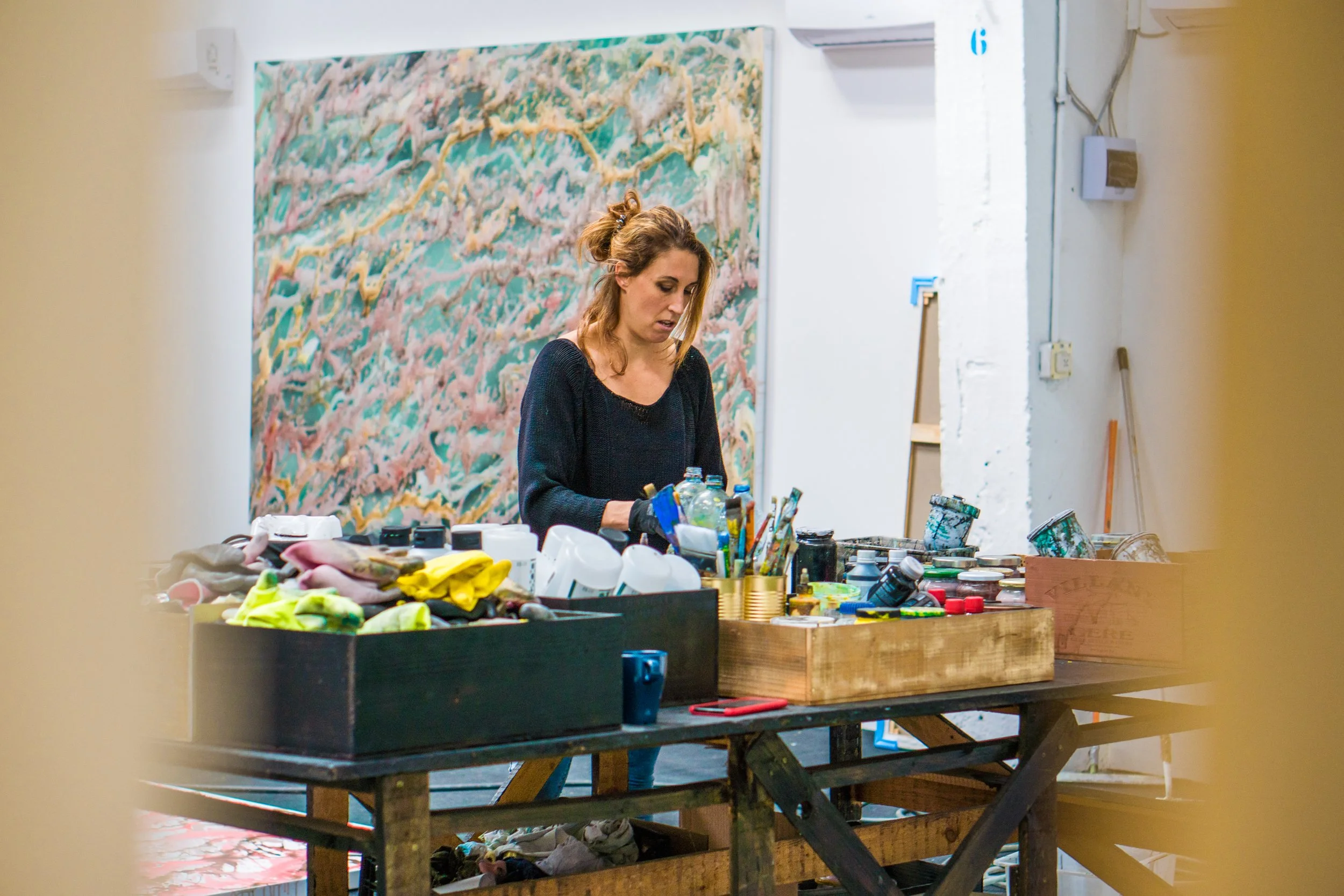
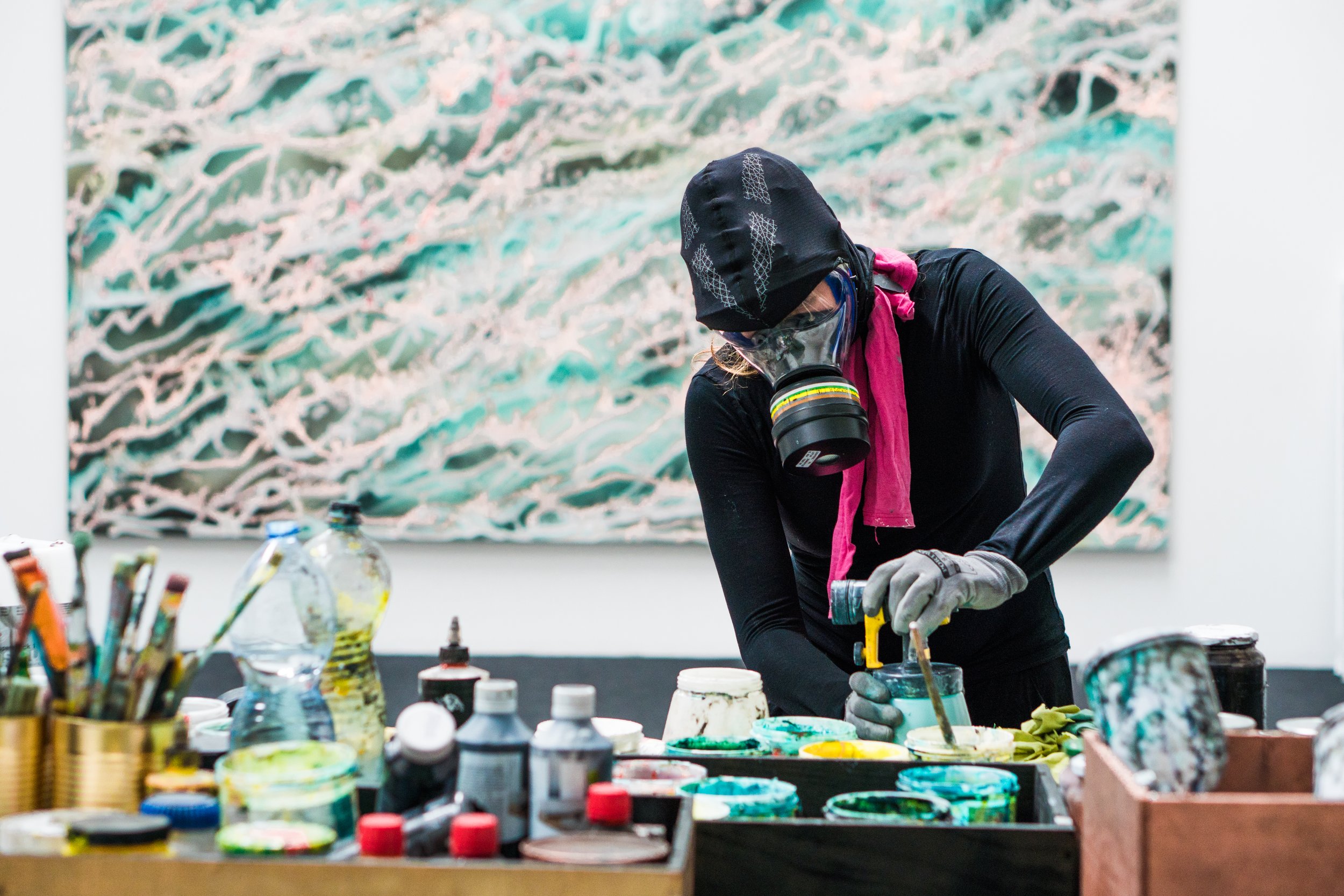
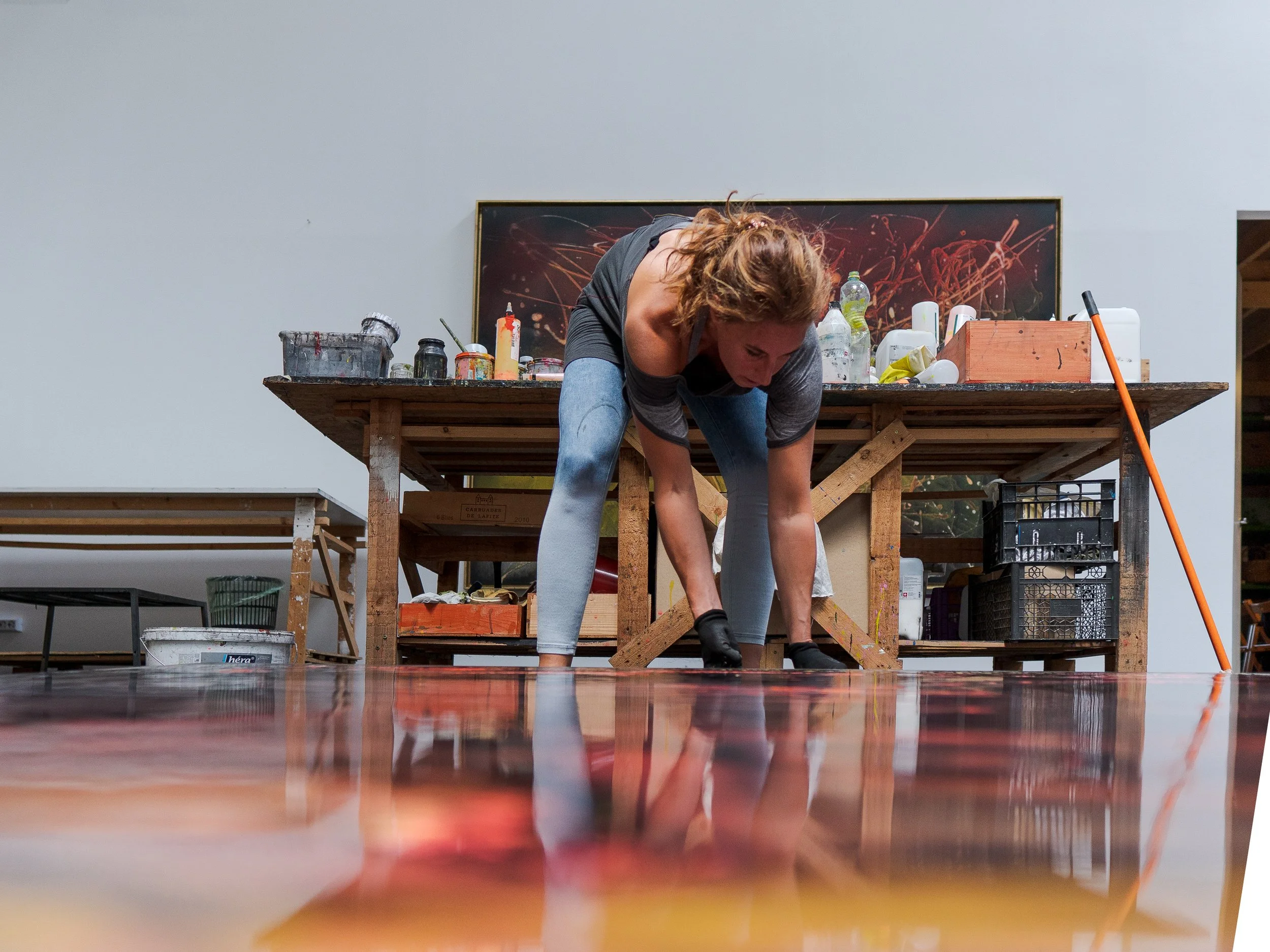
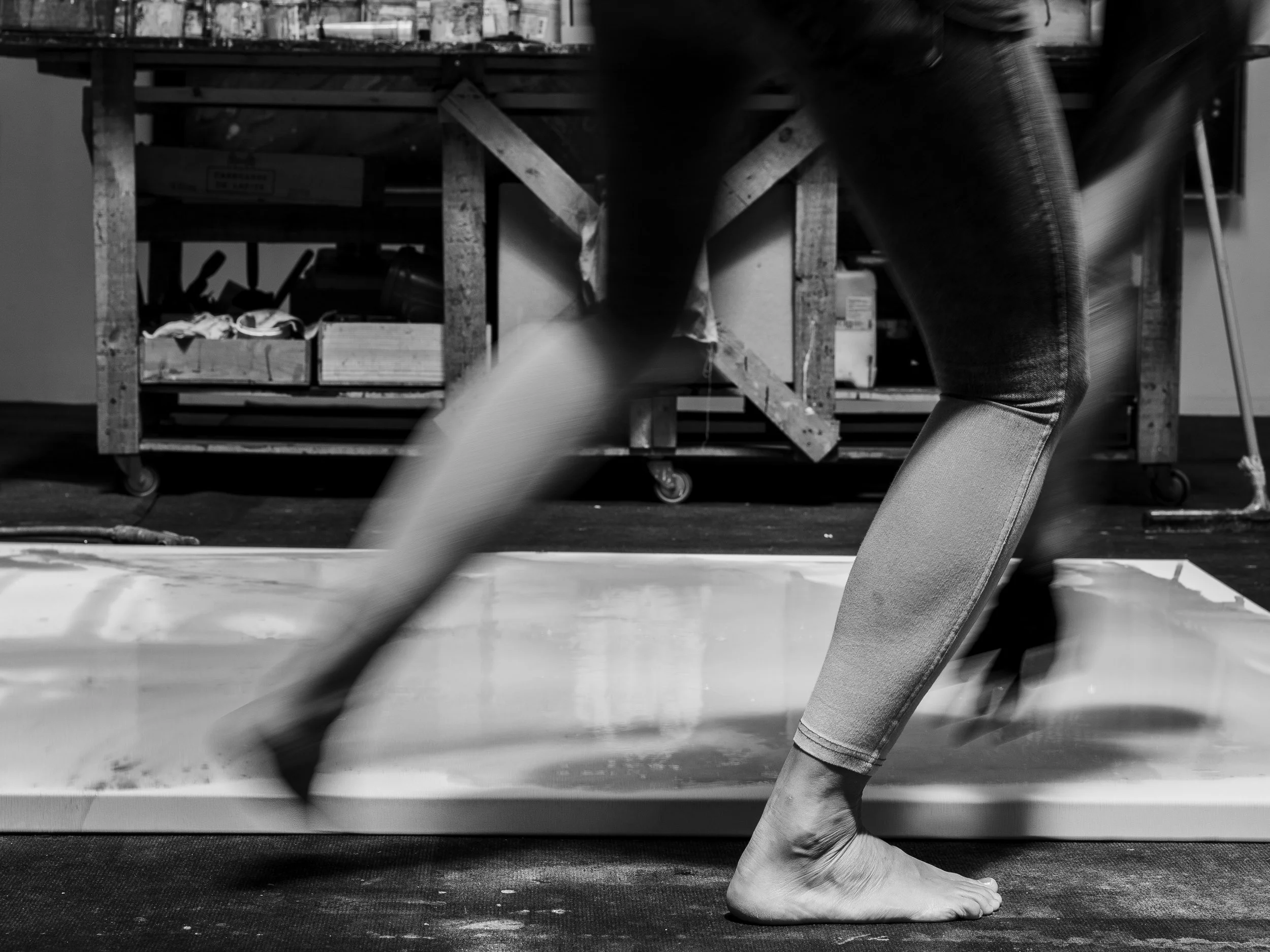
In her studio, Márta negotiates with gravity, chemistry, and chance, creating paintings and videos that capture transformation in motion.
Márta’s paintings do not depict nature so much as collaborate with it. Pigment moves, settles, separates, and resists, guided by gravity and time as much as by intention. In her studio, painting becomes an experiment in forces rather than images — a choreography between control and surrender where matter speaks back. What emerges is less a finished object than a moment of temporary equilibrium, a record of transformation caught just before it continues.
-
Good morning Marta! It is genuinely a pleasure to have the opportunity to do this interview with you, and we look forward to meeting you in person, at Helvetika 1575 in Zug at the end of the February. We always start by asking our guests what drew them to art—and if you hadn’t chosen art, what career might you have pursued?
I never consciously decided to become an artist. It felt inevitable, almost organic. Looking back, I realize that what attracted me to art was not image-making, but process. I was interested in how matter behaves — how gravity pulls, how viscosity resists, how surfaces absorb and repel. I was drawn to movement, transformation, and the invisible forces behind things. I was fascinated by water, by erosion, by how something fluid could constantly change form yet remain itself. That curiosity never left me. If I hadn’t become an artist, I probably would have ended up studying chemistry or physics. But in a way, I already do that. My studio is a laboratory. I experiment constantly. I test combinations that aren’t “recommended.” I fail a lot. And those failures are usually the most exciting part.
-
Márta, spending time with your work, it’s hard not to notice how present the forces of the physical world are within it. The materials seem to be allowed their own voice — to move, to settle, sometimes even to resist — which brings to mind, in very different ways, the gestures of artists like Jackson Pollock and Helen Frankenthaler, and later figures such as Anish Kapoor, Olafur Eliasson, Lynda Benglis, Pae White and Jessica Warboys. Your pieces often feel less like fixed objects and more like something held in a delicate state of balance, somewhere between intention and letting things happen. I’m wondering when you first became aware of this sensitivity to how materials behave — was there a particular moment or place where that curiosity began? And over time, did that attentiveness naturally lead you toward physics and chemistry as part of your thinking?
It wasn’t one big moment. It was years of trial and error. At some point I realized that paint isn’t passive. It has its own personality. It moves, resists, separates, cracks. It behaves according to its own laws. When I started tilting canvases, mixing additives in strange ratios, interrupting drying processes, I began to see reactions I couldn’t fully predict. That’s when things became interesting. Nature has always been my biggest inspiration — especially water and the ocean. In my early works you could almost see waves, waterfalls. But later I stopped trying to depict nature and instead started working with it directly. Over time I became very sensitive to gravity, viscosity, evaporation — the physics of it all. But not in a textbook way. I learned it through my hands, through mistakes, through repetition. There’s a moment in the process when something unexpected appears, and you know immediately: that’s alive. That’s real. That’s what you keep.
-
Your paintings have this amazing sense of flow and pattern, both organic and carefully crafted. I’m curious—how has growing up in Hungary, with its avant-garde art traditions, its deep connection to nature, the balance of discipline and adaptability you experienced in the post-socialist era, and its culture of intellectual curiosity, influenced the way you work with materials, approach abstraction, and think about the creative process?
Honestly, I was too young and geographically far from the historical avant-garde centers in Hungary to be directly influenced by them. I didn’t grow up consciously referencing those traditions. What truly shifted my perspective was studying at Montclair State University and being exposed to the New York art scene. That environment taught me courage. It showed me scale, fearlessness, and conceptual ambition. It encouraged experimentation without apology. That experience gave me permission to push my own work further — physically and mentally. At the same time, I think growing up in Hungary shaped me in a quieter way. There’s a certain seriousness, a respect for thinking deeply. I’ve always felt that we are not separate from nature — we’re inside it. My work aligns with a biocentric understanding of the world, where human agency is only one factor among many. That perspective feels deeply European in its roots — especially in relation to thinkers like Steiner, who saw nature as a unified system of forces. But honestly, my biggest teacher has always been the material itself.
-
When you paint, it feels less like making an image and more like entering a situation— setting forces in motion and letting them meet. Philosophers like Deleuze and Whitehead describe reality as always becoming rather than arriving, Niebuhr reminds us of the tension between what we can shape and what we must accept, and Cobb emphasizes our interconnection within a larger web of events. Do you experience the studio as a place where things unfold beyond your control, where you are part of the process, and how do you sense the moment when a process has said what it needs to say?
Yes, absolutely. The studio is not a place where I impose control — it’s where I initiate a situation. What truly interests me is the process itself — the choreography. The result matters, but the real tension and challenge live in the unfolding. I am part of a kind of collaboration with matter. I design the parameters carefully, but there is always a moment when I must let go. That moment is crucial. If I control too much, the work dies. If I release too early, it collapses. I know a painting is finished when it feels balanced — not calm, but resolved. Like the forces have argued enough and reached a temporary agreement.
-
Márta, if you would allow us one [semi] private question! You don’t surrender control; you shift it. Your authority lies in designing the conditions — materials, scale, surface, timing — that allow unpredictable behavior to occur. Chance operates, but only within a system you’ve carefully constructed. What results is not randomness, but discovered order — a moment where intention and matter briefly align. The question is whether your process mirrors life itself. We do our best to plan, to control the small, practical details—how we get to work, which train we take, what time we leave the house. But life keeps reminding us how fragile that control really is. Be five minutes late, step onto a different train, and suddenly you’re surrounded by different people, different possibilities. That small shift might lead to a chance meeting, or place you in the middle of something you never could have predicted.
Is your process a way of reaching for a sense of control we know we can never fully have—while also accepting that uncertainty, coincidence, and the unexpected aren’t flaws in life, but part of what makes it real?
You described it very beautifully — Yes, I do believe I need structure first. I need to plan. I cannot enter the studio blindly and just “see what happens.” Before I even start, I think carefully about scale, ratios, timing, surface. I prepare everything as precisely as I can. No matter how detailed the plan is, the materials respond in their own way. Gravity shifts. A chemical reaction behaves slightly differently. A surface absorbs more or less than expected. And that’s where the work truly begins. Total control is an illusion. But that doesn’t mean we abandon structure. In fact, structure creates the space where accident can become meaningful. I don’t see errors as failures — I see them as openings. Very often, the most important discoveries happen when something doesn’t follow the plan.
Life is exactly like that. We make plans because we need orientation. We choose the train, the time, the direction. But life introduces other forces — coincidence, delay, encounter, loss, surprise. The question is not whether we can control everything. We can’t. The question is how we move within those shifts. In my work, I feel that tension very strongly — between intention and matter, between precision and surrender. It reflects what I believe more and more: that human control is always partial. We collaborate with forces larger than us — time, entropy, gravity. That fragile negotiation is where the painting lives. And maybe where life does too.
-
Márta, your work feels so alive and experimental, really driven by materials, paint, and the way chance and physical forces come together. It seems like your focus is on exploring these processes rather than on gender, which is really interesting. At the same time, I can’t help but notice that being a successful female artist in a field that’s often male-dominated carries a kind of significance. Even if gender isn’t central to your work, it seems to shape how you experience the art world and maybe how others see you.
I also love how on Instagram you highlight artists like Louise Bourgeois, Lee Krasner, Agnes Martin, and Grace Hartigan, like you’re connecting with a lineage of women who pushed abstraction forward, without letting gender define their art.
How important is it for you to be recognized as a female artist? Does that recognition matter to you, or influence the way you see your work and place in the art world?
When I work, I genuinely don’t think in terms of gender. In the studio, I feel almost neutral — absorbed in material, gravity, chemistry, timing. The process demands full attention. It’s about forces interacting, not identity. However scale, courage, boldness — are qualities that historically were coded as masculine in painting. Women fought hard to claim space within abstraction, especially in fields like large-scale gestural painting that were long dominated by male narratives. So the effort is not about rejecting femininity — it’s about refusing limitation. I want the work to stand on its own terms. But I also understand that visibility matters. And if my presence contributes to widening the space for women in large-scale, process-driven abstraction, that is meaningful. Ultimately, though, I don’t position myself strategically within the art world. My practice unfolds the way my paintings do — gradually, through persistence, experimentation, and long-term commitment.
-
Márta, your exhibition opens as Hermann Nitsch’s closes. Hermann Nitsch pulls the senses to their limits—bodies, blood, and raw matter staged as ritual, shocking and intense, a theater of life, death, and catharsis that can be overwhelming. His work feels visceral and symbolic, where the body becomes both instrument and message, and the audience is plunged into emotional and ethical turbulence.
And then there is you, Márta. Watching paint flow, fold, and respond to gravity and chance in your hands feels alive, as if the materials themselves are speaking and you are listening. Your body moves through this process gently, guiding emergence rather than commanding it, inviting viewers into a space that is calm, immersive, and meditative. Where Nitsch confronts, you mesmerize; where he shocks, you enfold. Your work allows us to drift into the rhythm of materials, becoming part of the unfolding rather than just watching it happen.
Do you see part of the role of art as sparking reflection? Do you hope that experiencing your work can be cathartic, in its own quiet, contemplative way?
That’s a generous description, thank you. If art can spark reflection, I think it happens in very different ways for different people. I don’t try to provoke or overwhelm. I hope that when someone stands in front of the work, they feel a kind of slowing down. Maybe they become aware of time passing. Maybe they notice small changes. Maybe they feel calm for a few minutes. If that becomes cathartic, it’s not because I designed it to be. It’s because the viewer allows themselves to enter that space. I don’t want to instruct anyone how to feel. I just create the conditions and step back. Some people connect deeply. Some don’t. That’s completely natural. Art, for me, is simply an honest attempt to work with what fascinates me. If that offers someone a quiet moment of reflection, then I’m grateful.
-
Last year at Photo Basel we discovered the work of Vincent Fournier… Your work seems to capture the inner life and movement of natural systems, while his shows their outer, mediated appearance. How do you feel your approach speaks to or dialogues with artists like Vincent?
I find Vincent Fournier’s work contemplative and poetic. I don’t see a direct conceptual connection between our practices, except in experimentation. We both focus on endless variation within a single theme. They are different approaches to the same vast subject.
Marta, your work, like Marina Abramović’s, is all about energy and presence, but in such different ways. You pour your intensity into your paintings, letting gestures, layers, and color carry motion and feeling, while Marina uses her body to push limits and connect directly with people in the moment. Your art draws viewers in quietly, inviting reflection, whereas hers confronts them head-on. Both of you, though, capture that raw, powerful intensity of experience. How does it feel to have your work shown alongside hers, with such different ways of expressing presence?
Showing alongside an iconic figure of contemporary art is an honor. Marina Abramovic uses her body as medium; I use material behavior. She confronts directly; I invite immersion. I feel there is a silent dialogue between us — two different languages exploring energy and transformation, perhaps a shared investigation of presence.
WithTechnology and AI at the forefront of the world, and by extension in the art world, your work came to mind when we looked at the videos on your website. It was fascinating to watch what viewers typically don’t see in your art, I.e.: the motion and reaction that is the foundation of your creations and that you experience in your studio prior to freezing them in a single moment. It was also reminiscent of the works created by Refik Anadol. Where Refik Anadol uses algorithms to keep data in continuous transformation, your paintings capture the volatile interaction between body, material, and chemistry at a fixed instant. If machine learning can now simulate those same reactions and let them unfold indefinitely—even beyond the rules of physics, would stopping it—fixing it in one moment—be an act of control, or an act of loss?
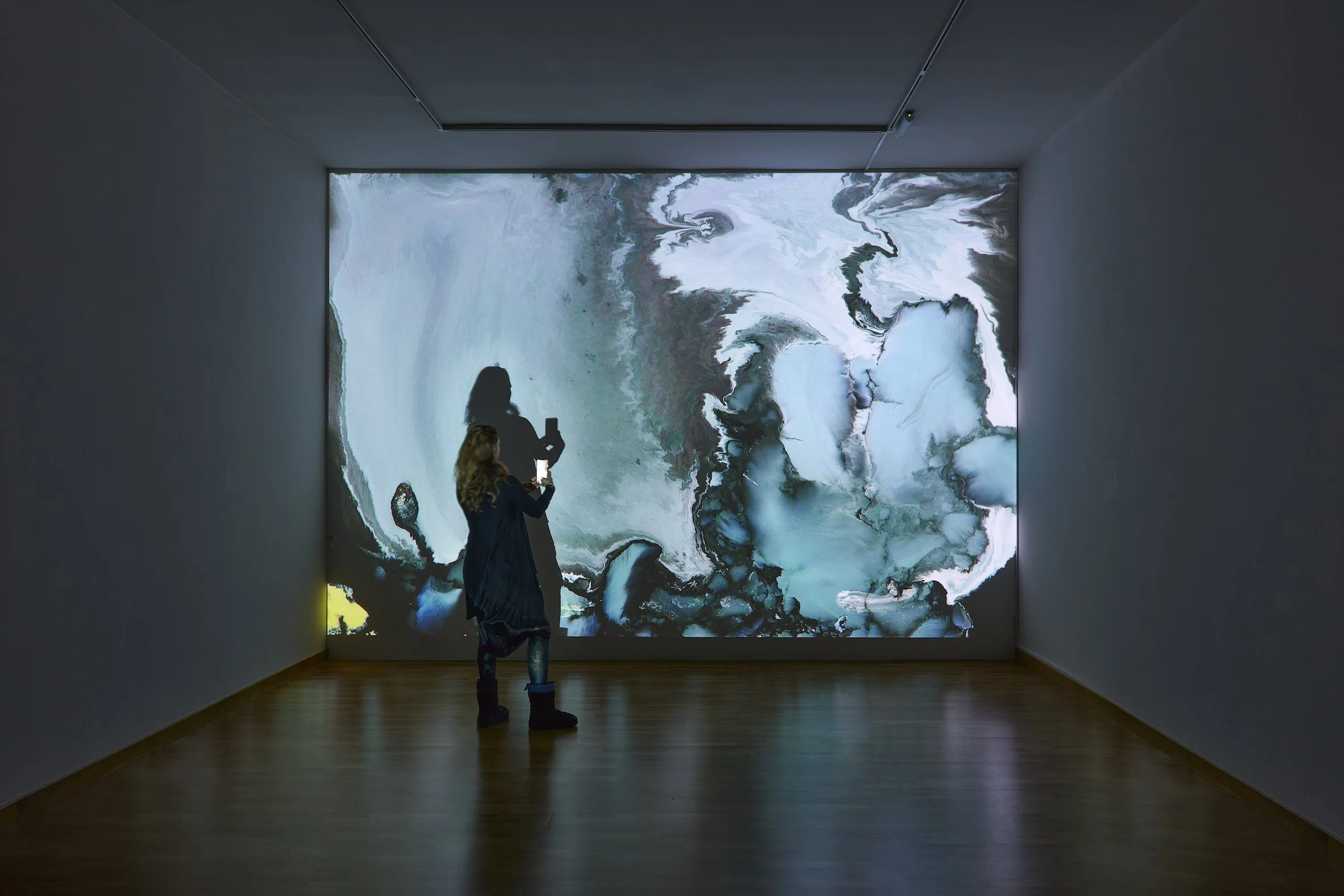
I admire Refik Anadol's work and his exploration of data as living material, and the conceptual framework behind his work. My work operates through physical processes rather than algorithmic ones. My videos are analogue, real-time recordings of chemical reactions. They document gravity, viscosity, evaporation — actual forces acting upon material. Viewers often question whether what they see is computer-generated or astronomical imagery. That ambiguity interests me. It reflects how closely physical reactions can resemble cosmic events. If machine learning can simulate endless transformation, that is fascinating. However when I allow a moment to crystallize — it is not an act of domination. It is a recognition that the forces have reached temporary equilibrium .
As a follow up to the previous question, your titles often hint at sensations or states rather than specific subjects, leaving interpretation open to the viewer. In your video works, however—such as Beautiful Error (2022) or I Must Improve (2023)—the soundtrack seems to guide the movement, creating an almost “oceanic” rhythm. Watching the same videos without sound, one can perceive entirely different images, like a cloud formation from space or a fetus in the womb, a fluid and liquid ballet. How do your video installations differ from your canvas works in terms of ideation, preparation, and intended outcome? Do you anticipate different reactions from viewers? And how do these varied outcomes influence your own perception of the work once it’s complete?
The essential difference between canvas and video is duration. The video focuses on the process - what I actually most enjoy in painting. The painting freezes a moment. It captures a state in which motion has paused, but the memory of transformation remains visible in the surface The video, by contrast, extends the process. It allows the viewer to witness the genesis and rearrangement of material in real time. The soundtrack can guide perception, but without sound, entirely different interpretations emerge. I welcome that multiplicity. Once the work is complete, it no longer belongs to me alone — it continues to unfold in the viewer’s imagination.
-
Because of the nature and process of your work, the scale, the technique and intent many artists, writers and poets come to mind when imagining a group show. If your dream exhibition could exist, who would stand beside you on the walls, in what space would it unfold, what music would float through the air, and where would you place yourself—what thoughts, feelings, and wonders would accompany you as you move through it?
My dream exhibition would bring together artists working with energy and transformation — perhaps in an industrial space, large and raw. I imagine sound as minimal and atmospheric. I would want viewers to feel suspended — between micro and macro, between control and dissolution.
-
Helvetika 1575 has, from its inception built a reputation for a strong and focused program and built thoughtful relationships with discerning collectors who value depth and longevity over first impressions. When someone lives with one of your works for years, what do you hope it continues to offer them — emotionally, physically as it ages in their space, and philosophically as their own life unfolds around it?
When someone lives with my work, I hope it keeps unfolding for them. Small details appear and disappear. I imagine it doesn’t reveal everything at once. Emotionally, I like to think it brings a sense of calm, maybe even a quiet depth. And in a very simple way, it might remind people that nothing is completely fixed — that things shift, and that this isn’t something to be afraid of. It’s just how life works. Working with Helvetika 1575 feels very natural to me for this reason. There’s no rush. There’s space for conversation and long-term thinking. That slower rhythm matches the way I work in the studio — patiently, layer by layer, letting things develop over time.
As a follow up question, when you imagine your work finding its home, who do you hope is waiting for it? What kind of inner landscape, sensitivity, or way of seeing feels aligned with what you create? Do you welcome a living dialogue with those who collect your work — a slow unfolding exchange of thoughts and reflections — or do you prefer that the work stand on its own, speaking in silence as it weaves itself into the collector’s life?
I welcome dialogue, but I also believe the work must stand on its own. It should integrate naturally into a life, not dominate it. My paintings and videos are not instant images. They unfold slowly. It weaves itself into the space and into the rhythm of the someone's world. It doesn’t need me there to explain it. In fact, I prefer when it speaks quietly, without mediation.
You’ve experienced many different art worlds — from artist-run initiatives to large international institutions. Now, with After Attention, you’re working with Helvetika 1575 that stays close to your process and engages directly with its collectors and audience. What feels different for you in this context? Does the closeness, the slower pace, or the direct dialogue open up something new in the way you think about or share your work?
My work is process-based. It unfolds gradually, both in the studio and in the viewer’s perception. So working in a context that values depth over speed feels aligned with how I think and operate. In large institutional exhibitions, like the current museum show in Yunnan, the work engages with architectural scale and cosmological framing — it speaks in a vast register. Here at Helvetika 1575, in a more intimate setting, the work shifts scale psychologically. The dialogue becomes more personal. I find that meaningful. It humanizes the work.
-
Actually perhaps one more! In doing research we stumbled on these words which we have chosen to present as a poem:
“Her work is not really about abstraction.
It’s about instability.
liquids between states
matter between control and collapse
images between forming and dissolving.”
A raw vision of your art, which certainly feels like a chronicle of our current world, and of our lives, affected by the greatest instability humanity has experienced in close to a century. Do your concerns about our world, our planet, the energy of these concerns permeate into your process? What keeps you awake at night? And to [really] close this interview, what is it that makes you smile?
Yes — instability is central. We live in a time of fragility — ecological, political, personal. These concerns inevitably permeate my work. What keeps me awake is the accelerating imbalance between humanity and nature. What makes me smile is simple: joyful moments with family, nature, small everyday miracles, and those rare moments in the studio when matter surprises me in the most beautiful way.
-
In closing, would you share any upcoming projects with us?
I recently opened a major solo exhibition at the Yunnan Provincial Museum in China, Nature, Immortality and the Cosmos. It is an important milestone, and my largest solo presentation so far — both in scale and conceptual depth. Presenting that work within a cultural context attentive to cyclical time and renewal reinforced the core of my practice: transformation as continuity.
In her studio, Márta moves quietly among pigments, surfaces, and gravity, attuned to every shift and hesitation. She smiles at moments when the materials surprise her, when something she didn’t plan becomes beautiful, fleeting, alive. “The most important discoveries happen when something doesn’t follow the plan,” she reflects, almost softly, as if sharing a secret. Her work is a gentle invitation to notice, to pause, and to feel the subtle rhythms that run through both nature and our lives. It is intimate, patient, and full of care — a reminder that even in uncertainty, there is joy, connection, and wonder.
-
Specialising in contemporary art, Helvetika 1575 supports and promotes the careers of leading international and visionary artists whose practices shape and challenge the global discourse of art today.
Through a dynamic programme of exhibitions, publications, and interdisciplinary collaborations, the gallery is committed to fostering meaningful engagement among artists, collectors, and audiences worldwide.
Founded and supported by a private foundation, HELVETIKA 1575 is devoted to presenting and promoting the work of its artists, advancing their creative visions, cultivating their legacies, and ensuring their voices resonate within an international context.
The gallery is housed in a beautifully restored 16th-century palazzo in the heart of Zug’s historic old town, a site that once served as a medieval goods transshipment center, a testament to the city’s rich mercantile heritage. Overlooking Lake Zug and framed by the Swiss Alps, the space harmoniously bridges past and present through its architectural blend of history and modernity.
Within this unique setting, HELVETIKA 1575 stands as a platform for artistic innovation and cultural exchange, a place where heritage becomes the foundation for the future of contemporary art.
ARTISTS:
ADDRESS
Unter Altstadt 20
6300 Zug
Switzerland
OPENING HOURS
Mon Closed
Tue-Sat 10:00-19:00
Sun 12:00-18:00
20th Painting Action
The Helmut Essl’s private collection presented Hermann Nitsch’s 20th painting action from 1987 during the 59th Venice Biennale, at the Oficine 800.
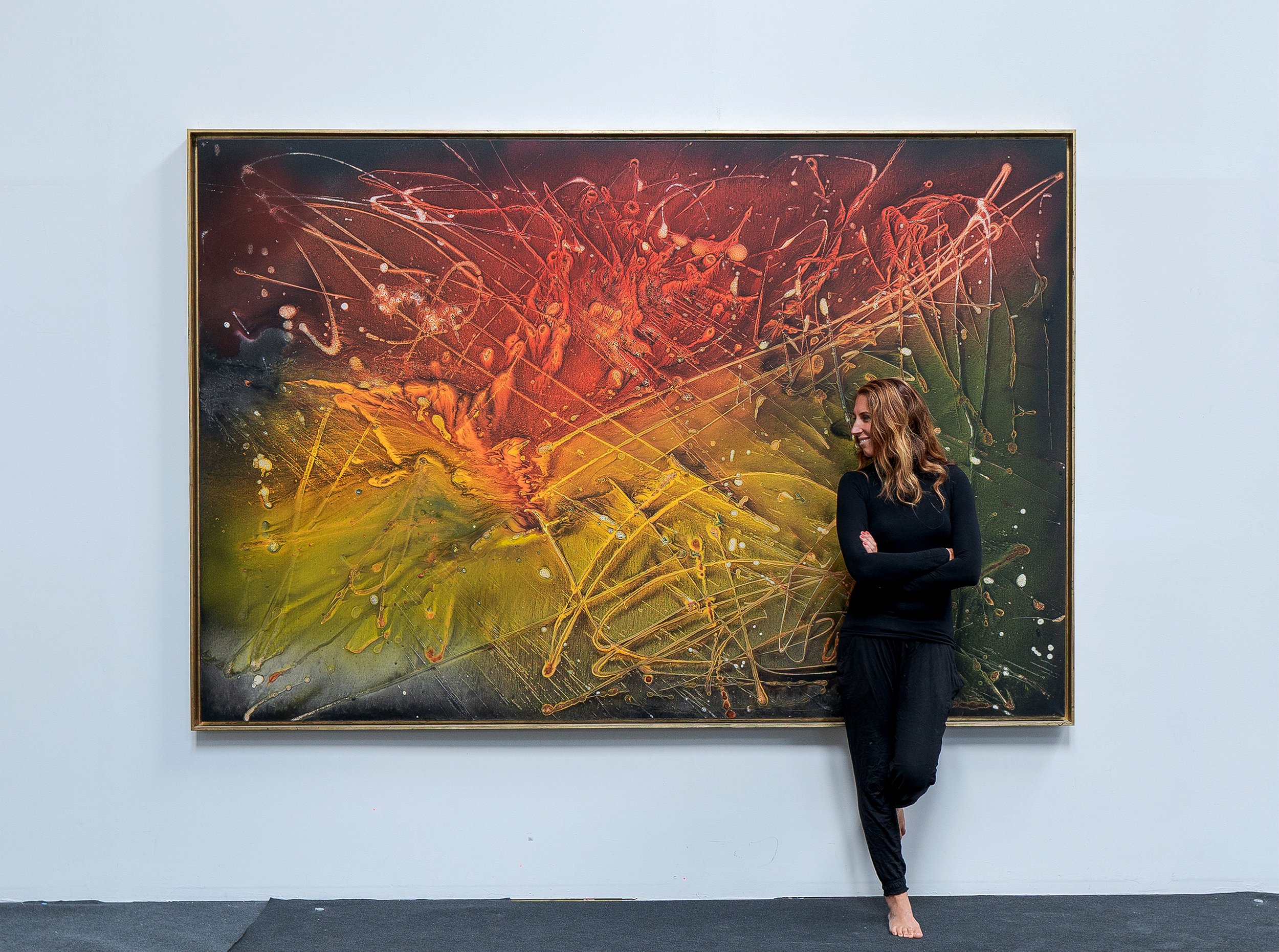
This painting action takes on a special role in Nitsch’s oeuvre, as it was performed and exhibited at the Vienna Secession. We are very pleased that these works remain in one hand – the Helmut Essl’s private collection.
The works of the 20th painting action in the Wiener Secession reveal impressively their genesis that took place between ‘unleashed outbreaks of fury and delicate gestures’. We are immersed in a pictorial, actionist environment in which the basic constants of his work spread out visually, located between the momentary and the eternal, the dynamically moving and the contemplatively calm, the real and the symbolic, between purity and defilement, excessive demands and reflection.
With the large-format poured painting (5×20 m) on the front wall, and numerous smaller splatter and poured paintings flanking it, a space-filling panorama is created, illustrating like no other in condensed form the essence of Nitsch’s painting as an integral component of his ‘Orgies Mysteries Theater’ conceived in a synaesthetic manner.
Nitsch declared: “I wanted to show how the spilling, squirting, smearing, and splashing of red-coloured liquid can evoke a sensorily intense arousal in the viewer, inviting sensorily intense sensations.” As part of his comprehensively conceived ‘Orgies Mysteries Theater’, the painting action is intended to trigger in the public a heightened experience of sensory reality, ideally leading to reflection on one’s own existence.
The renewed integration of the works from the 20th painting action in the historical space of the Oficine 800 on the island of Giudecca not only enables a recapitulation of his most important works; it also allows Nitsch’s artistic ideas located between the ecstatic and the contemplative to be re-traced and re-experienced.