

Hermann Nitsch
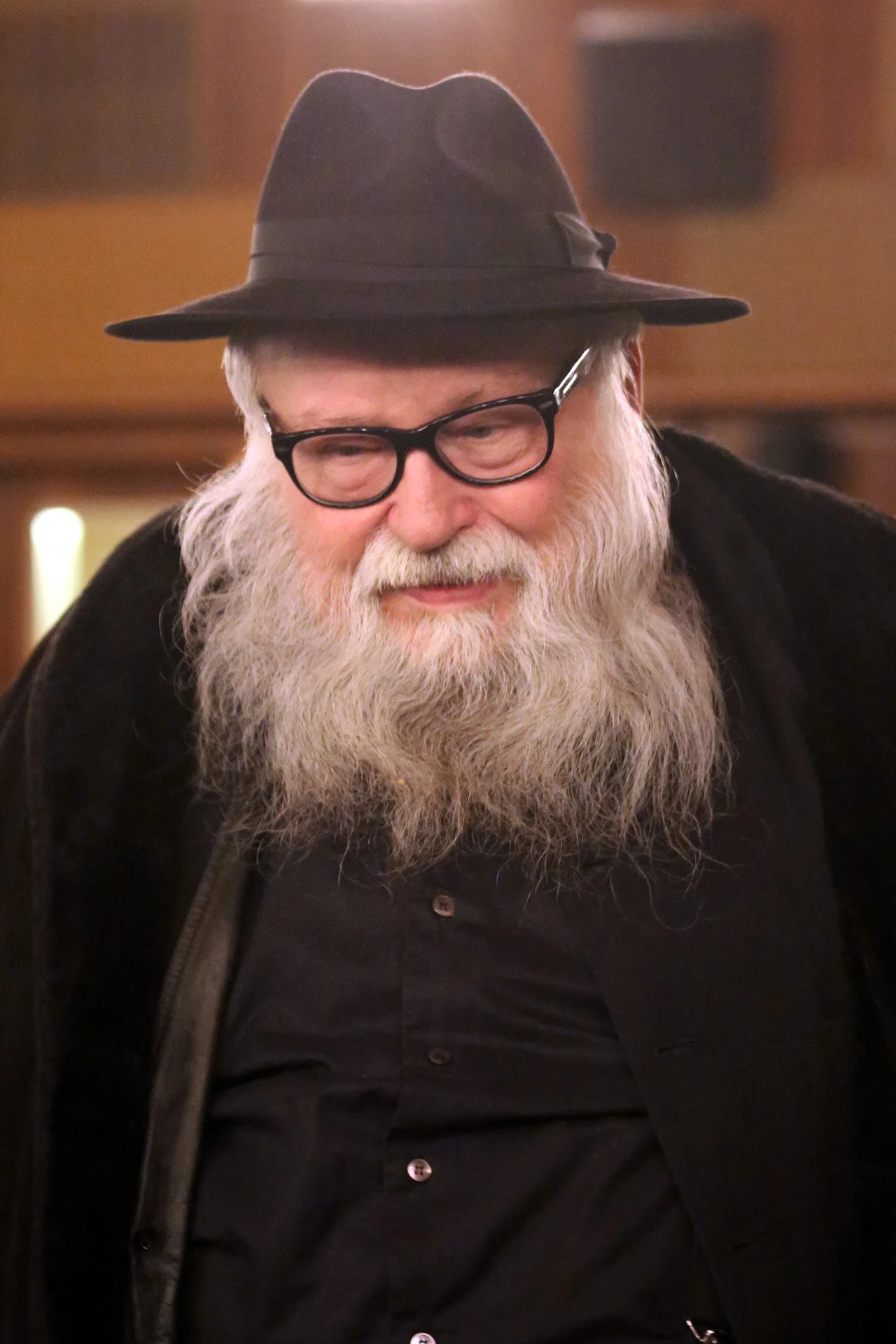
Hermann Nitsch, Viennale 2012. Manfred Werner / Tsui via Wikimedia Commons
the orgies mysteries theatre
painting action
Paint flies, hisses, and splashes.
The artist moves with it, body and mind in unison,
pouring energy onto every surface.
Red and black trace instinct, emotion, and abandon.
Nothing is represented—only the act, only the pulse of creation.
Each drop vibrates with intensity, awakening viewers
to the raw sensation of the moment.
Action painting becomes ceremony, performance, ecstasy made tangible.
-
Hermann Nitsch (1938–2022)
Artist, Composer, Founder of the Theatre of Orgies and Mysteries
Hermann Nitsch, one of the most radical and influential figures of postwar art and a founding member of Viennese Actionism, was born in Vienna in 1938 and passed away on April 18, 2022, at the age of 83.
Marked profoundly by childhood experiences during the Second World War—including daily bombing raids and the death of his father on the Eastern Front—Nitsch developed early into a staunch opponent of nationalism and political ideology. These formative experiences shaped a worldview that would later inform his uncompromising artistic practice, centered on existential inquiry, sensory intensity, and the affirmation of life in the face of tragedy.
After training at the Vienna Graphic Arts College, Nitsch moved from figurative studies to abstract painting and began developing a visionary Gesamtkunstwerk (total work of art) that synthesized painting, music, theater, ritual, philosophy, psychoanalysis, and mysticism. Influenced by Greek tragedy, Wagnerian music drama, depth psychology (Freud and Jung), and religious rites across cultures, he conceived the Theatre of Orgies and Mysteries (O.M. Theatre)—a performative system intended to transcend language and engage all senses directly.
Beginning in the early 1960s, Nitsch’s actions and painting performances—often involving ritualistic elements, animal carcasses, blood, sound, and communal participation—provoked intense public controversy. He was repeatedly prosecuted and imprisoned, yet simultaneously gained passionate supporters internationally. Alongside Günter Brus, Otto Muehl, and Rudolf Schwarzkogler, he became known as one of the Viennese Actionists, a group that permanently transformed performance and body art.
From the late 1960s onward, Nitsch achieved major international recognition, performing and exhibiting across Europe and the United States. Landmark moments included participation in the Destruction in Art Festival in London (1966), Documenta in Kassel (1972, 1982), and major performances in New York, Naples, Florence, Paris, and Sydney. His work found particularly deep resonance in Italy, where long-term collaborations led to the founding of the Museo Nitsch in Naples.
In 1971, Prinzendorf Castle in Lower Austria became the permanent home of the O.M. Theatre. There, Nitsch realized increasingly ambitious versions of his life’s work, culminating in the monumental 6-Day Play, first partially staged in 1975 and fully realized in 1998 with hundreds of participants, orchestras, choirs, and extensive musical scores composed by Nitsch himself.
Parallel to his performative practice, Nitsch maintained an extensive career as a painter and composer. His large-format paintings, symphonies, organ works, and action scores were performed and exhibited internationally. He also designed stage sets and co directed productions at major opera houses, including the Vienna State Opera, Zurich Opera House, and the Bavarian State Opera.
From 1988 until 2001, Nitsch served as professor for interdisciplinary art at the Städelschule in Frankfurt, influencing generations of artists. His pedagogical work was inseparable from his artistic philosophy of continuous learning, sensory awareness, and existential intensity.
Major retrospectives of his work were held at the Essl Museum (2003), Martin-Gropius-Bau in Berlin (2006), the Albertina in Vienna (2019), and numerous international institutions. The Nitsch Museum in Mistelbach, opened in 2007, and the Nitsch Foundation, established in 2009, continue to preserve, research, and present his legacy.
Until his final years, Nitsch remained artistically active, creating exuberant paintings focused on resurrection, color, and Dionysian excess, and participating in large-scale projects such as the Bayreuth Festival (2021). His work persistently explored the tragic and ecstatic dimensions of existence, seeking to transform confrontation with death into a profound celebration of life.
Hermann Nitsch leaves behind a body of work that stands as one of the most uncompromising and expansive artistic visions of the 20th and early 21st centuries—an art that insists on lived experience, sensory intensity, and the eternal cycle of destruction and renewal.
-
The Orgies Mysteries Theatre
The six-day performance of the Orgies Mysteries (O.M.) Theatre is conceived as the ultimate celebration of human existence—a ritual of aesthetic glorification, a festival of consciousness. It is at once a folk festival and a mysterium, a coming-together to awaken the awareness of being-here. The O.M. Theatre has no purpose other than the mystical exaltation of life itself. It propels participants toward an existence fully realized, toward a conscious encounter with themselves.
The drama, elevated into a feast, does not abandon the primal essence of ancient tragedy; on the contrary, it seeks it out. The feast fosters a consciousness that embraces the depths of reality, including the tragic, the cruel, and the absurd. Life—with its joys, suffering, failures, and the inevitability of death—is fully acknowledged. Obstacles, pain, and the absurd serve not merely as hindrances but as catalysts for creative overcoming. The act of living, an ever-expanding unfolding of effort, naturally encounters suffering, spurring a pain-laced joy in overcoming.
The myth of death and resurrection manifests as an allegory of the creative act. The analytical techniques of the play invite us to understand ourselves more fully and uncompromisingly, exploring drives and desires often left uncharted. Repressed energies are unearthed and experienced; consciousness penetrates the energetics of existence, opening the most sensitive and ecstatic moments to awareness.
At its core, the O.M. Theatre fulfills the human need for abreaction. The drama acts as cathartic therapy—akin to psychoanalysis—yet in an aesthetic, communal form. Actions unfold toward intense climaxes that trigger elemental sensations, escalating into participatory, orgiastic enactments. Once societal censors are overcome, raw sensory stimuli—flesh, warmth, blood, water, excrement—evoke regression, releasing inhibited impulses. Pleasure in play, in soiling, in intensity, culminates in the Dionysian dismemberment of the self. Joy and cruelty merge; chaos and intoxication erupt, producing a mystical awareness of aggression and the primal nature of existence.
The O.M. Theatre follows Hölderlin’s understanding of the tragic: the power of nature and humanity fuses in rage, revealing the intimate pairing of god and man. Repression is dissolved, neuroses are illuminated, and collective myths of sacrifice are confronted. Through this rapturous frenzy of awareness and release, the dramatic effect reaches a climactic catharsis, liberated from the hopelessness of classical tragedy by aesthetic rendering and conscious engagement. Life itself is condensed into a mythical, intense experience.
The festival extends beyond the stage, radiating into everyday life. Every sense is heightened; every moment of existence is an opportunity for intensified awareness and joy. The excesses of experience are sublimated into a heightened vitality, rising toward altruistic love—not a moral commandment, but a supreme state of being, the highest expression of life itself. Love becomes the mystical energy flowing through the entirety of existence, celebrating the rapture of being fully alive.Description text goes here
-
Lose Yourself. Find Being. Taste Infinity.
In essence, Orgies Mysteries Theatre channels Artaud’s intensity, Hölderlin’s tragic vision, and Nitsch’s ritualized excess, creating a six-day festival of living myth, ecstatic release, and full human awareness.
Nitsch – Orgien Mysterien Theater
Took Artaud’s and Hölderlin’s ideas into extreme ritualized, participatory performance.
Known for graphic, sacrificial, and Dionysian enactments: blood, flesh, ritual, and sensory overload.
Focused on abreaction, catharsis, and the ecstatic liberation of repressed drives—embodying Artaud’s sensory assault with Hölderlinian tragic awareness.
Life, myth, and ritual merge in performative excess, making audience and performers part of a living, ecstatic “myth of existence.”
Artaud – Theatre of Cruelty
Focused on sensory assault, ritual, and immersion.
Theatre is a living, transformative experience, aimed at revealing repressed drives, desire, and existential truths.
Actions are chaotic, visceral, often violent, intended to break habitual perception and awaken the unconscious.
Hölderlin – The Tragic
Tragedy is life at its extremes, where human striving meets the overwhelming power of nature or the divine.
It fuses rage, joy, and vitality, revealing the depth of existence.
Art allows us to experience the tragic safely yet intensely, cultivating awareness and the mystical bond between humanity and cosmos.
Antonin Artaud
“I do not propose cruelty for its own sake, nor chaos as a cult of destruction. I speak of cruelty because what is repressed does not disappear; it returns in distorted, unconscious forms. The regulated world that prides itself on measure and reason is saturated with concealed violence, sublimated domination, and sacrificial myths that operate without awareness. To refuse their appearance is not moral restraint but blindness.
Tragedy did not originate as literature. It emerged from ritual, intoxication, and collective excess, from moments in which human beings confronted the forces that exceeded them—nature, death, divinity, desire. Hölderlin understood this when he recognized tragedy as the moment where the innermost human core and the power of nature become one without limit. Modern theatre that clings only to representation betrays this origin and reduces tragedy to a cultural ornament.
What I call abreaction is not a therapeutic cure in the naïve sense. It is an exposure. The sado-masochistic structures that govern sacrifice, obedience, and guilt must be enacted consciously in order to lose their unconscious power. As long as they remain hidden, they rule. When they are rendered visible and aesthetic, they cease to function as fate. This is not the glorification of excess but its demystification.
The aesthetic form is essential. Without form, excess collapses into brutality. With form, it becomes experience capable of reflection without distance. The catastrophe we reach is real, but it no longer imprisons us in tragic hopelessness. Classical tragedy ends in resignation because it accepts necessity as absolute. Our catastrophe opens awareness. It does not deny finitude, but it refuses to sanctify suffering as destiny.
Those who demand ethical distance misunderstand the danger of distance itself. Distance has become the primary instrument of repression. It allows cruelty to persist abstractly while experience is anesthetized. Only participation can undo the collective neuroses that are themselves collective in origin. Individual insight is insufficient where the unconscious is social.
Love, in this context, is not a moral instruction and not a sentimental promise. It is what becomes possible when fear, domination, and repression loosen their grip. Love is not imposed; it arises as a state of heightened vitality, of openness to the other, once the psychic economy of sacrifice has been exhausted. It is not opposed to intensity but born from its sublimation.
I do not claim final liberation. I claim necessity. A society that refuses to confront its repressed foundations will endlessly reproduce them in politics, sexuality, and violence. The orgiastic, the cruel, the excessive must be passed through consciously, not avoided, if they are to lose their power. Only then can life cease to be governed by unconscious catastrophe and become, instead, a field of intensified being.
What I seek is not the abolition of tragedy but its transformation—so that what once bound humanity to fate may now open it to life.”
Friedrich Hölderlin and the Tragic Condition of Modernity
Friedrich Hölderlin occupies a singular position in the intellectual history of modernity, not merely as a poet influenced by Greek tragedy, but as a thinker for whom the tragic constitutes a fundamental structure of existence. In Hölderlin’s work, tragedy is neither reducible to dramatic form nor to biographical misfortune; rather, it names a historical and ontological condition characterized by irreconcilable tension between finitude and the absolute.
Central to Hölderlin’s tragic vision is his diagnosis of the modern age as one marked by the withdrawal of the gods. Unlike the ancient Greeks, whose tragic consciousness unfolded within a horizon still illuminated by divine presence, modern humanity exists in a state of separation. The divine is no longer immediately accessible, yet the longing for unity with it persists. Tragedy thus emerges not from the absence of desire, but from its persistence in a world incapable of fulfilling it. This condition produces what Hölderlin repeatedly figures as homelessness (Heimatlosigkeit), a spiritual and historical dislocation that defines modern subjectivity.
Hölderlin’s engagement with Greek tragedy, particularly Sophocles, is therefore not antiquarian but philosophical. He does not seek to revive ancient forms; instead, he interrogates the conditions that made them possible. In his theoretical writings on tragedy, Hölderlin emphasizes the role of the caesura—the interruption that halts the flow of representation and prevents total identification between human and divine. This interruption is decisive: it preserves difference and thereby prevents the catastrophic fusion that would annihilate human finitude. Tragedy, in this sense, is not the reconciliation of opposites but the sustained exposure to their non-identity.
This logic finds its most explicit articulation in The Death of Empedocles. Empedocles’ desire to dissolve himself into the elemental whole represents the temptation of absolute unity. Yet Hölderlin stages this act not as fulfillment but as tragic impasse. To achieve unity, Empedocles must negate himself as a human being; to remain human is to endure separation from the absolute. No synthesis resolves this contradiction. The tragic consists precisely in the impossibility of a non-destructive reconciliation.
Language and poetry are not exempt from this condition. Hölderlin attributes to poetry a privileged relation to being, yet he remains acutely aware of its limitations. Poetic language gestures toward the divine without claiming possession of it. Its truth lies not in completion but in measured restraint, in the capacity to sustain openness rather than closure. The formal features of Hölderlin’s late hymns—abrupt transitions, tonal instability, and moments of sobriety—enact this tragic logic at the level of expression itself.
The often-invoked connection between Hölderlin’s tragic vision and his later mental illness must be approached with caution. While any romanticization of suffering is to be rejected, it remains significant that Hölderlin’s life dramatizes the difficulty of inhabiting the tensions his work articulates. His eventual withdrawal from public and poetic life may be understood, not as a resolution of tragedy, but as its remainder—what persists when articulation reaches its limit.
In this respect, Hölderlin emerges as a paradigmatic figure of modern tragedy. He does not offer redemption, synthesis, or consolation. Instead, his work insists on the necessity of enduring division without abolishing difference. Tragedy, for Hölderlin, is not an event but a condition—one that defines modernity itself as a historical space in which the divine is absent, yet not forgotten.
-
Emerging after the Second World War, action painting rejected representation in favor of concrete processes enacted directly on the pictorial surface. Paint was no longer treated as color but as substance—paste, liquid, matter—smeared, splashed, poured, or hurled onto the canvas through bodily gesture. The act of painting unfolded in time and became central: a visible trace of physical movement, sensory excitation, and psychic release. What mattered was not depiction, but the event itself and its perceptible intensity.
Rooted in art informel and tachisme, action painting brought subliminal sensations to consciousness through form. It activated elementary sensory experience—extroverted, visceral, and immediate—while paradoxically demanding heightened sensual awareness. In this way, it gave aesthetic form to deeper psychic layers: repressed impulses, libidinal energies, and the unconscious. The stain, splash, and smear functioned as conduits through which inner reality surfaced, transforming sensory excess into a conscious aesthetic event.
For the artist, action painting became inseparable from theatre. The painting act was understood as a dramatic, time-based performance, inclined toward ritual and ecstasy. Pouring and splashing fluids—especially red paint—formed a visual grammar that translated theatrical action onto pictorial planes. Gradually, the constraints of the canvas were abandoned, and painting expanded into space, merging with performative actions and real events. Paint turned into blood; the surface became the wall, the body, reality itself.
Rather than a revival of art informel, action painting here is conceived as a timeless, fundamental structure: a spontaneous, ritualized practice that recurs within action theatre. It serves as both precursor and parallel to theatrical actions, rehearsing the intensification, excess, and sensory agitation later enacted with flesh, blood, and material reality. Across decades, painting actions—often public and durational—have functioned as large-scale ritual events, emphasizing process over result and affirming action painting as a bridge between image, performance, and lived experience.
-
The performances at Prinzendorf Castle were primarily centered around Hermann Nitsch’s Orgien-Mysterien-Theater, which is what he called his large-scale, immersive art rituals. Breakdown:
Nature of the Performance
Nitsch’s work was not a conventional theater performance. It was a ritualistic, multimedia experience combining:
Music and chanting
Painting and body art
Dance and movement
Animal carcasses and blood (symbolic, in line with sacrificial motifs)
The performances were intended as spiritual catharsis, exploring the connection between life, death, ecstasy, and the sacred.
Participants were sometimes active partakers, not just spectators.
Location and Setup
The castle itself was integral to the work:
The castle courtyard, halls, and surrounding grounds became stages.
Large-scale installations were often built on-site.
Performances could last hours or even days, with audience members entering and leaving at different points.
Scale
These events often involved hundreds of participants:
Musicians, performers, and volunteers
Spectators who were sometimes invited to interact with the ritual elements
Nitsch referred to these performances as “actions” rather than plays.
Controversy and Impact
Because of the use of blood and animal sacrifice, the performances were often controversial and occasionally led to legal scrutiny.
They are now considered pioneering examples of Viennese Actionism, a movement emphasizing physicality, shock, and ritual.
Legacy
Prinzendorf Castle became the permanent hub for these performances.
After Nitsch’s death, the site continues as a museum and performance space, preserving his methods and archives.tem description
-
the essentially new dimension of my theatre is the overcoming of role-play by staging real happenings. real happenings automatically call for the gesamtkunstwerk. they are to be experienced tangibly through all five senses. they can be tasted, smelt, they are to be heard, to be seen and to be touched. besides the visual dominance of my theatre, which strives to uncouple itself from language, noise is a key factor. noise takes over for the moment the role of music in my gesamtkunstwerk. my music has its roots in crying out, in clamor, it is tied to the most extreme excitation, which is a necessity of theatre. in terms of human history, the scream precedes the word, it occurs whenever excitation is so intense that the word is not enough. my music is in no way illustrative or imposed on the actions. it comes literally from the excitation generated by what’s happening and its commotion. it intensifies the action, the action activates the music. it digs deeper into the abysses of the drama’s catastrophe. subsequently my acoustic composition has moved beyond the extreme archaic possibilities of expression, which i would nevertheless leave entirely. the acoustic color has become increasingly crucial. a kind of organ sound emanating from the whole orchestra is being sought. i came across the music of the o.m. theatre directly through my immersion in the action.
before my efforts there was the music of the second viennese school, schönberg, webern, for whom i have so much respect that i did not want to simply rehash them. an eruption out of them had to be found. something newly born arose out of the action. chance acquired an important role. john cage contributed to this opening. on the other hand, very different sound dimensions were needed for the length of a 6-day play. enormous blocks and walls of sound were employed. the orchestration tends towards the gigantic. almost a turn back to wagner, bruckner and scriabin emerges. an orgiastic music is to transpose us to an intensive state wherein we find being. the o.m. theatre is comparable to a giant symphony with six movements. the sensory intensive impressions brought about the orgiastic disembowelment actions of the o.m. theatre, the experience of blood, flesh and intenstines, seen, smelt and tasted, is to escalate into roaring, belling sounds.
just as intrinsic to my music is the meditative calm of the adagio. the tranquility of the starry sky, the serene orbits of the heavenly bodies are to be savored and the universe losing itself in the infinite is to be sounded out. the music of this gesamtkunstwerk is the life-affirming mysticism of being. (1999)The musical philosophy and practice of the Orgies Mysteries (O.M.) Theatre, emphasizing a radical, sensory, and immersive approach to performance. The key points are:
Real Happenings over Role-Play:
The theatre aims to transcend traditional acting by presenting real events on stage, creating a fully tangible experience.
These events engage all five senses—sight, sound, taste, smell, and touch.
Music as Excitation, Not Illustration:
Music emerges organically from the intensity of the action rather than being pre-composed or descriptive.
It is rooted in primal human expression—screams and clamor—reflecting extreme emotional states.
The action on stage activates and intensifies the music.
Acoustic Innovation:
The music evolved beyond earlier 20th-century forms (e.g., Second Viennese School) while respecting them.
Chance operations (influenced by John Cage) and enormous “blocks and walls” of sound allow for sustained, large-scale compositions, suitable for long performances (up to six days).
Orchestration aims for a monumental, organ-like sound, reminiscent of Wagner, Bruckner, and Scriabin.
Orgiasitic and Meditative Duality:
Music mirrors the theatre’s extremes: violent, chaotic, sensory overload scenes contrasted with moments of meditative calm and cosmic contemplation.
The goal is a gesamtkunstwerk—a total artwork—where sensory intensity, musical experience, and mystical reflection combine.
Life-Affirming Mysticism:
Ultimately, the music expresses the mysticism of being, combining the ecstasy of human experience with the serene contemplation of the universe.
-
Specialising in contemporary art, Helvetika 1575 supports and promotes the careers of leading international and visionary artists whose practices shape and challenge the global discourse of art today.
Through a dynamic programme of exhibitions, publications, and interdisciplinary collaborations, the gallery is committed to fostering meaningful engagement among artists, collectors, and audiences worldwide.
Founded and supported by a private foundation, HELVETIKA 1575 is devoted to presenting and promoting the work of its artists, advancing their creative visions, cultivating their legacies, and ensuring their voices resonate within an international context.
The gallery is housed in a beautifully restored 16th-century palazzo in the heart of Zug’s historic old town, a site that once served as a medieval goods transshipment center, a testament to the city’s rich mercantile heritage. Overlooking Lake Zug and framed by the Swiss Alps, the space harmoniously bridges past and present through its architectural blend of history and modernity.
Within this unique setting, HELVETIKA 1575 stands as a platform for artistic innovation and cultural exchange, a place where heritage becomes the foundation for the future of contemporary art.
ARTISTS:
ADDRESS
Unter Altstadt 20
6300 Zug
Switzerland
OPENING HOURS
Mon Closed
Tue-Sat 10:00-19:00
Sun 12:00-18:00
-
Helmut Essl – Entrepreneur, Investor & Art Collector
Helmut Essl is an Austrian entrepreneur, investor, and art collector whose work bridges business leadership, healthcare innovation, and contemporary art. He is the founder of the HSO Holding Group, through which he built and scaled healthcare companies specializing in probiotic products and technologies aimed at improving human health. One of these ventures, HSO Health Care GmbH, developed an internationally recognized portfolio and was successfully sold to a global biotech group.
In addition to his entrepreneurial background in healthcare, Essl leads UTIPLY Family Office GmbH, where he oversees strategic investments across healthcare, fintech, real estate, and sustainable technologies. His investment approach is rooted in long-term value creation, innovation, and entrepreneurial thinking. He also operates Helmut Essl Management e.U., providing strategic advisory services, and holds executive roles in several companies across life sciences and real estate.
Parallel to his business activities, art collecting plays a central role in Helmut Essl’s life and identity. He is deeply engaged with contemporary and avant-garde art and is particularly committed to the work and legacy of Hermann Nitsch. Essl’s collecting practice reflects a profound appreciation for radical artistic expression, performative intensity, and the philosophical dimensions of art. His engagement goes beyond ownership, encompassing long-term dedication to artistic discourse, preservation, and cultural significance.
For Helmut Essl, collecting art is not a passive pursuit but an active dialogue with creativity, history, and provocation. He views art as a vital counterbalance to entrepreneurship—one that demands vision, conviction, and the courage to challenge conventions.
Helmut Essl’s profile stands at the intersection of entrepreneurship, investment, and cultural patronage, uniting economic innovation with a deep commitment to the arts.
20th Painting Action
The Helmut Essl’s private collection presented Hermann Nitsch’s 20th painting action from 1987 during the 59th Venice Biennale, at the Oficine 800.
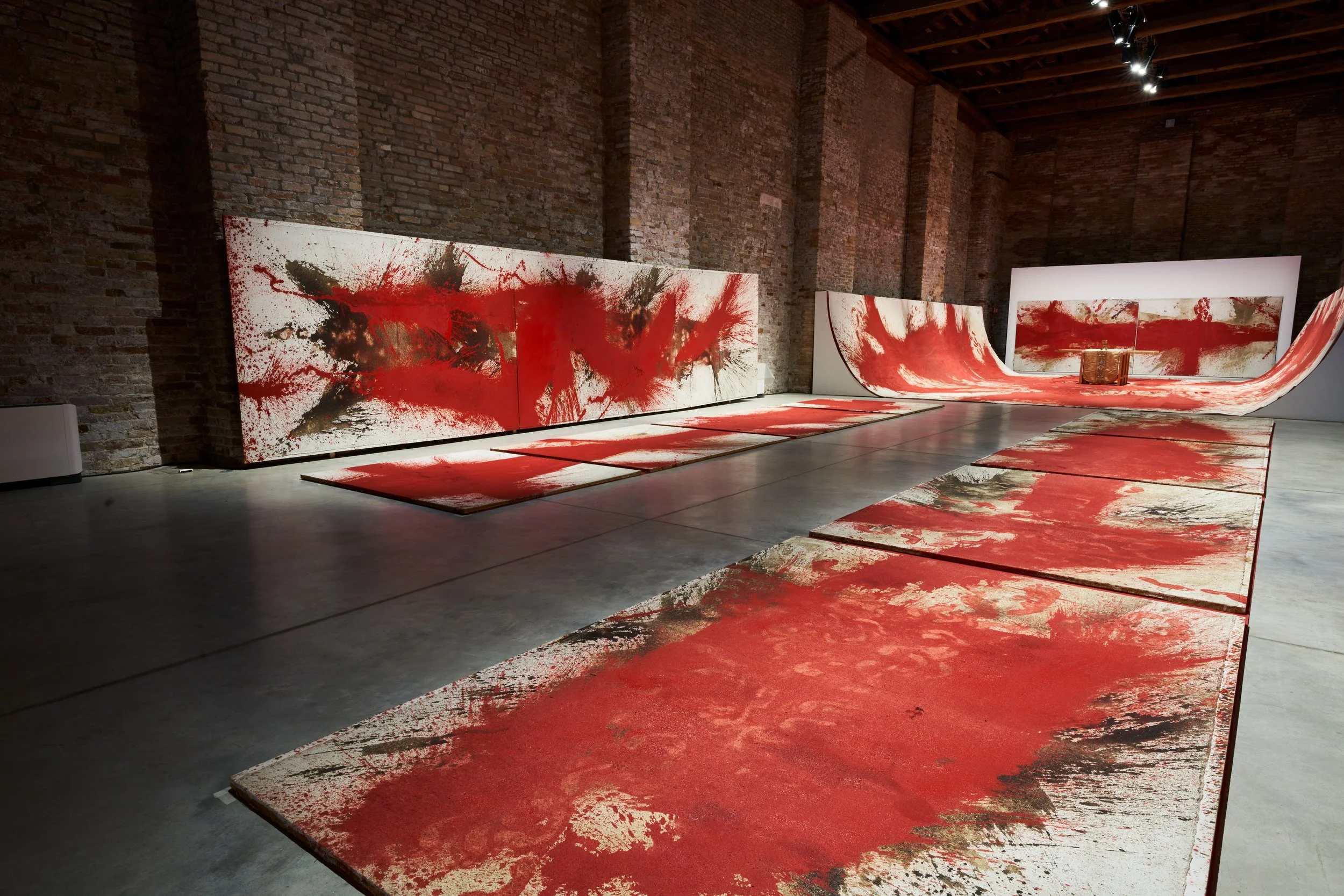
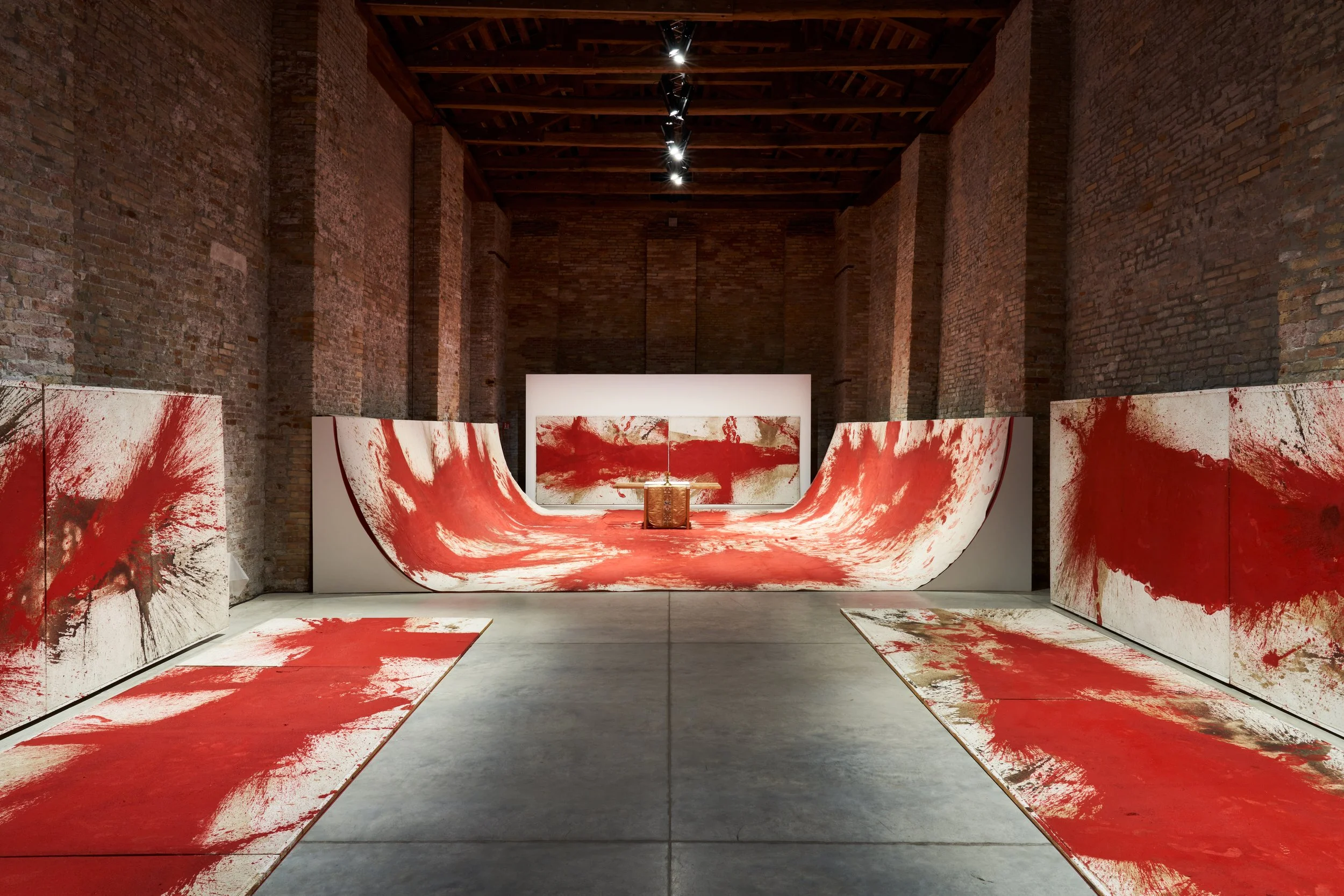
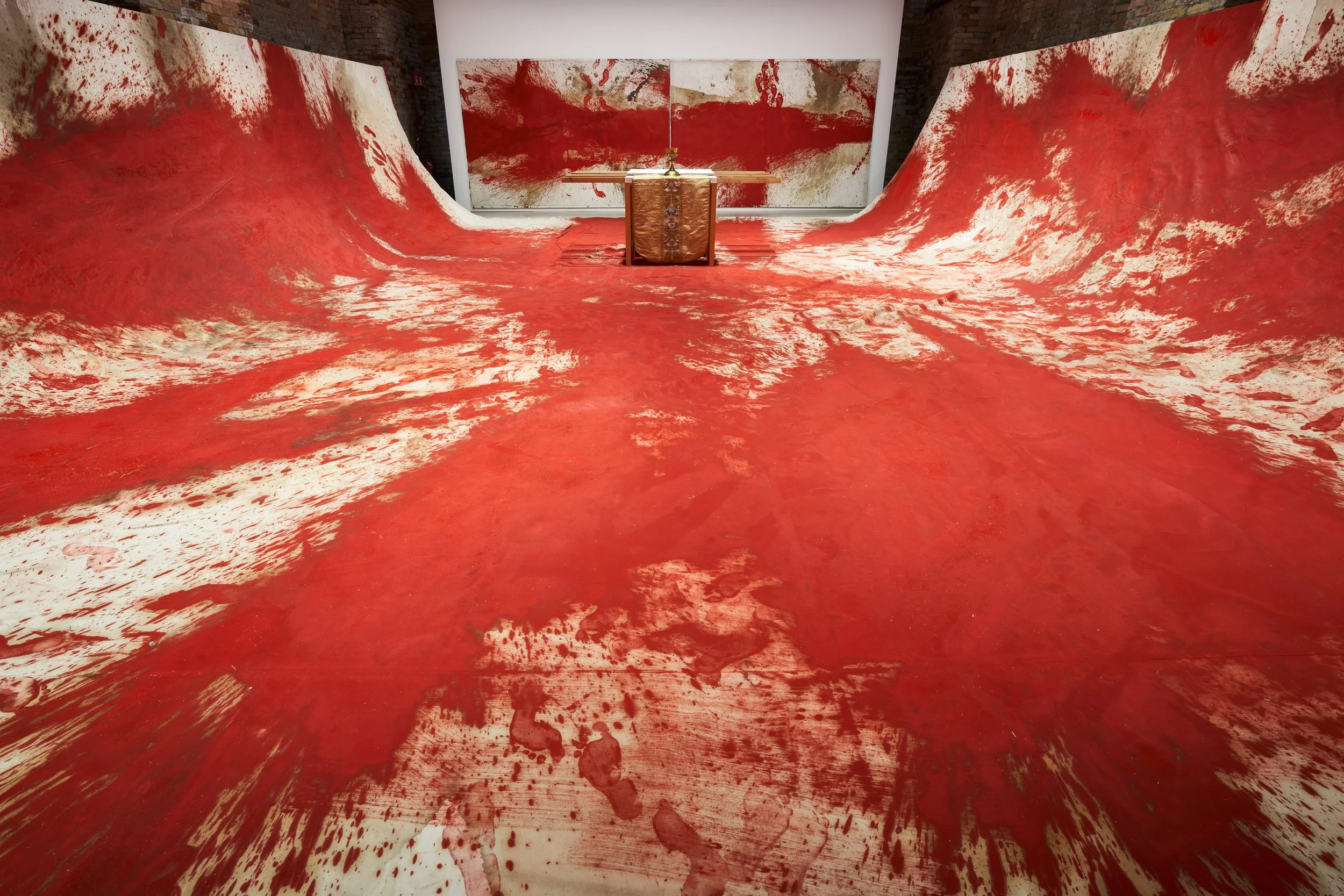
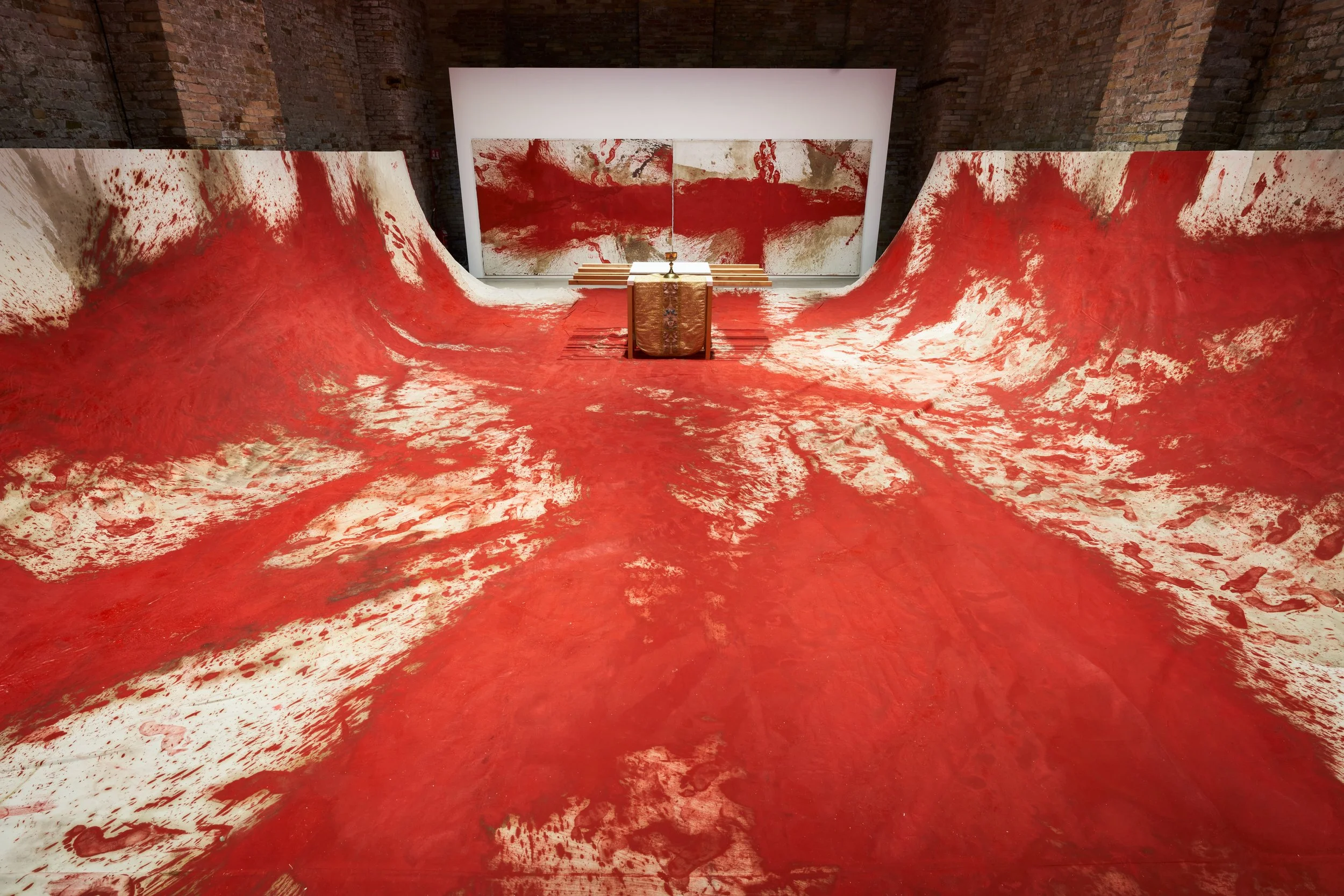
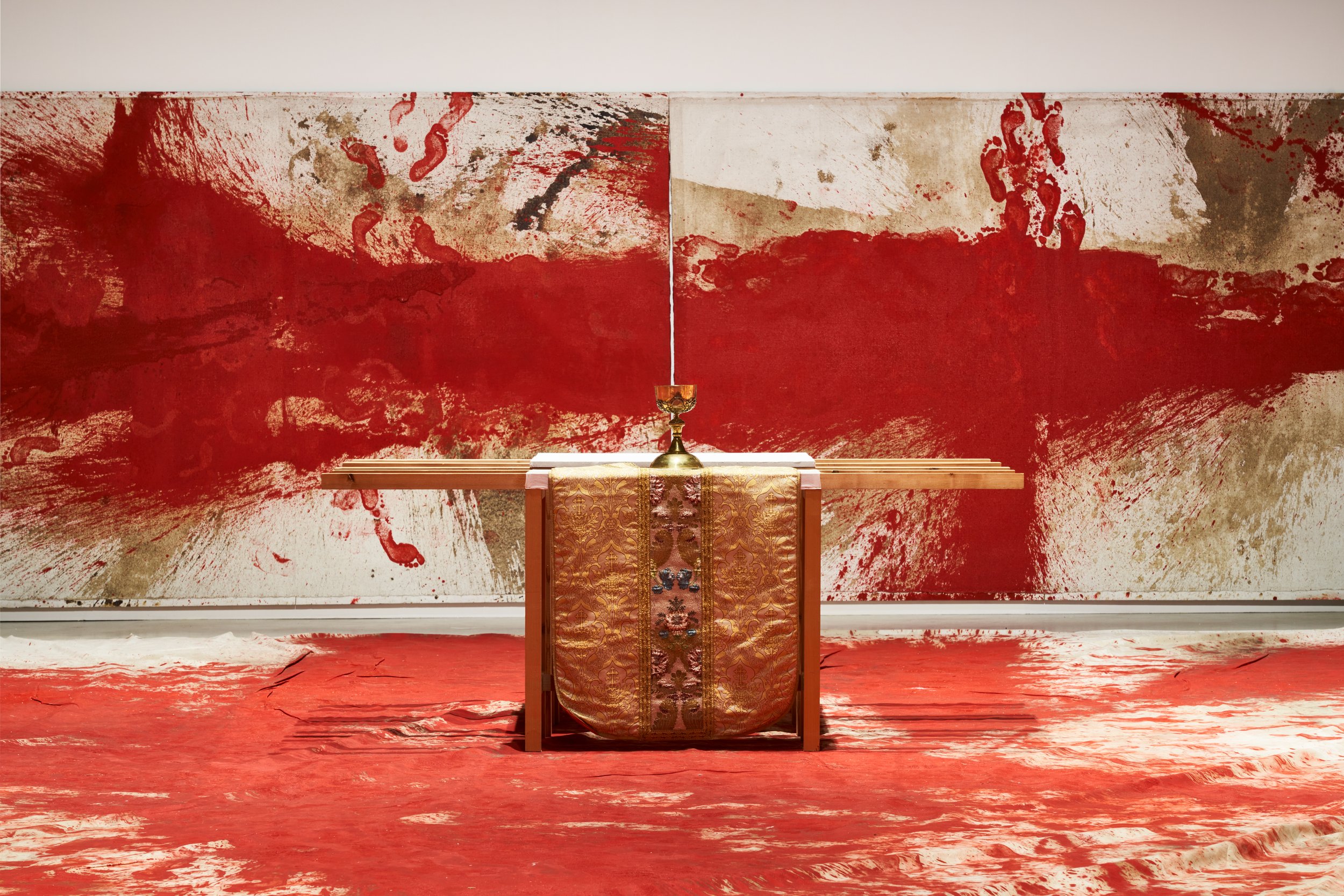
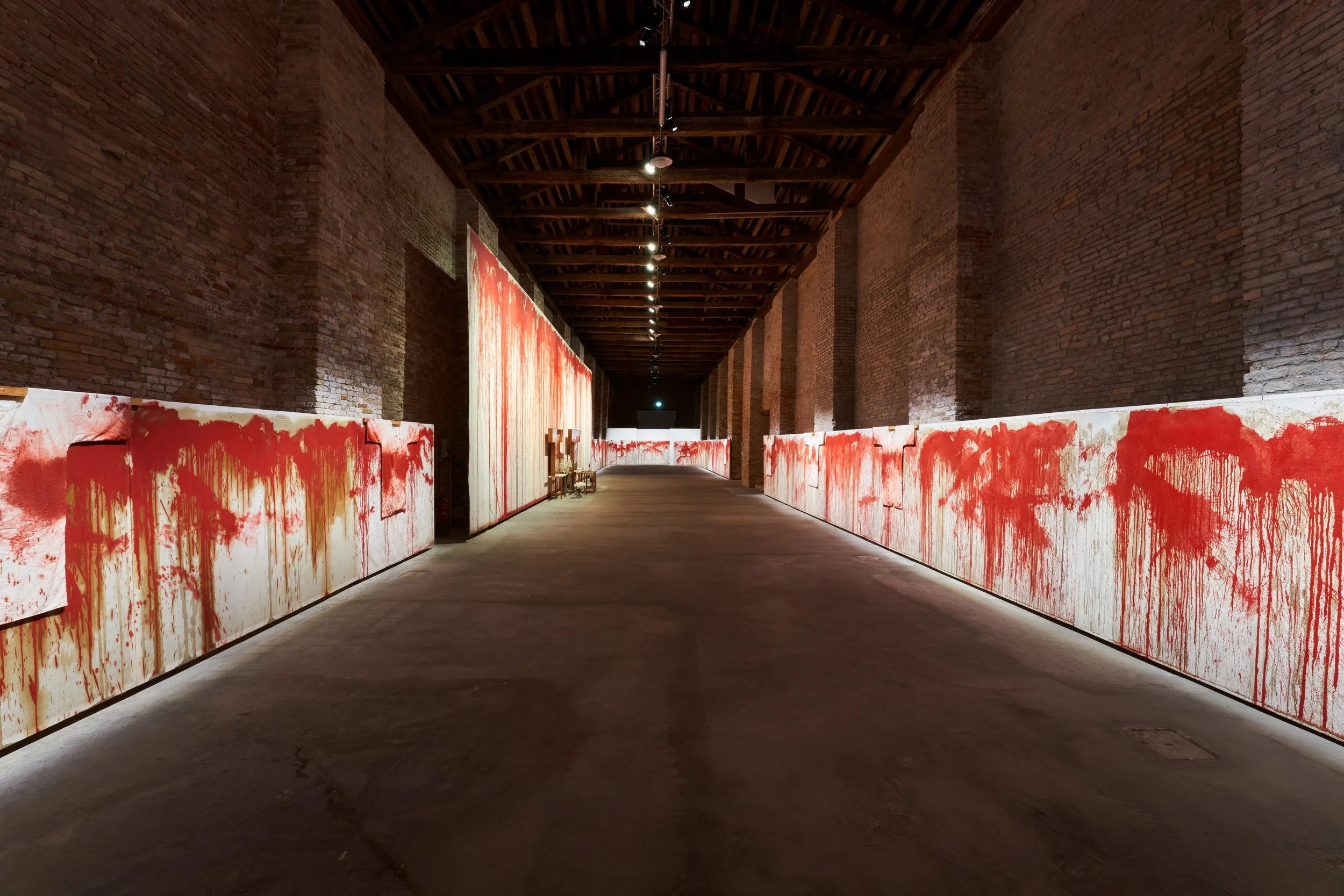
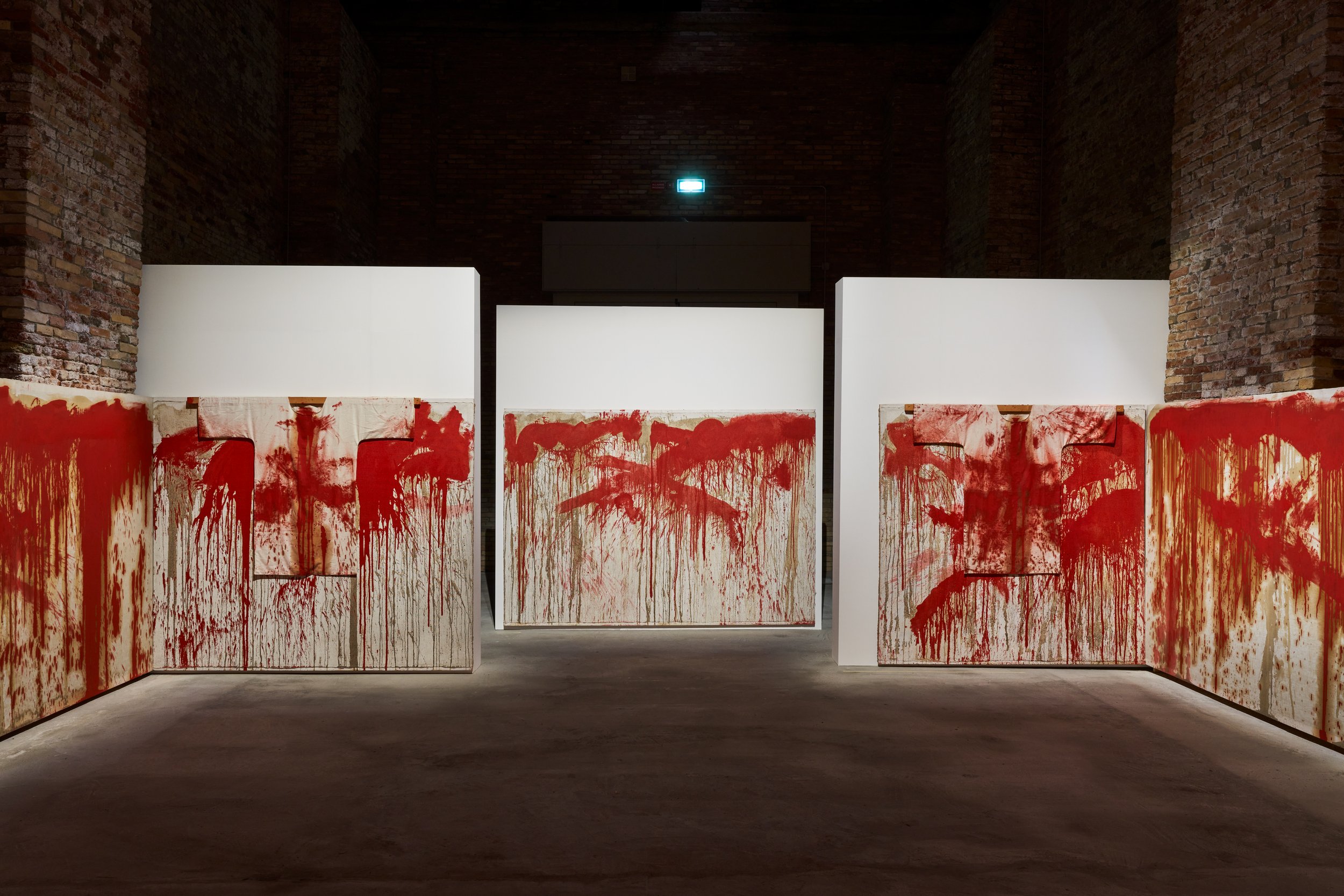
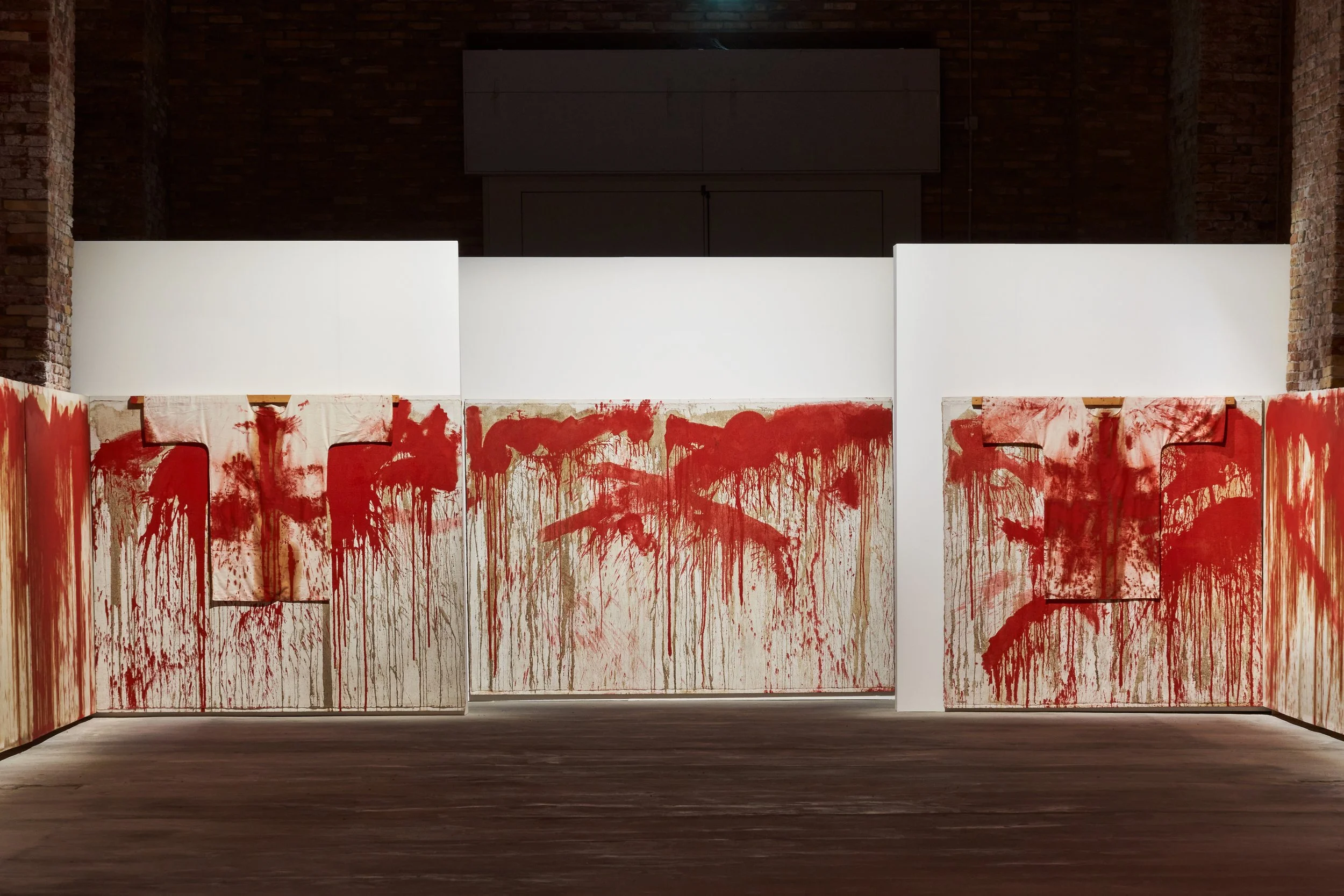
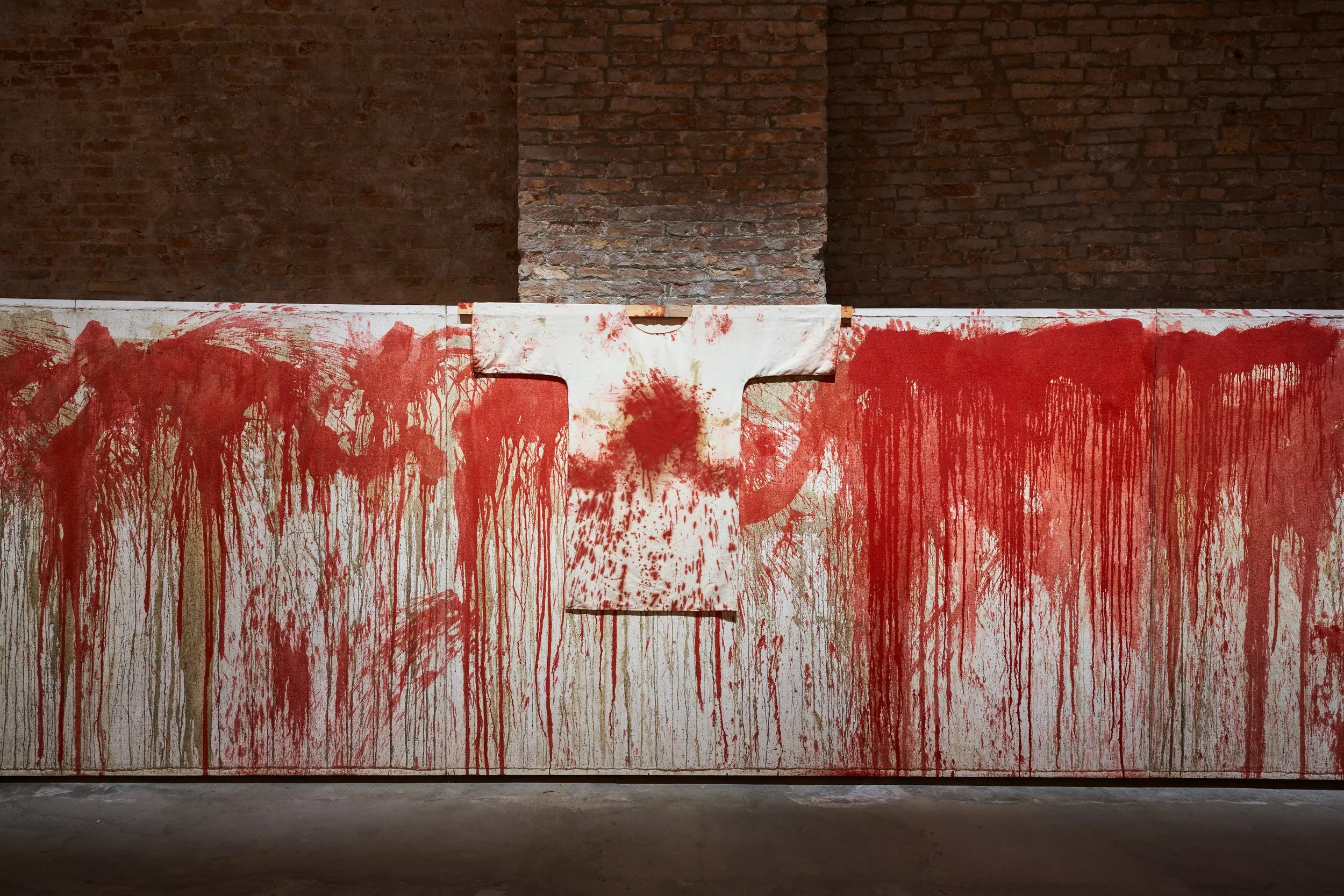
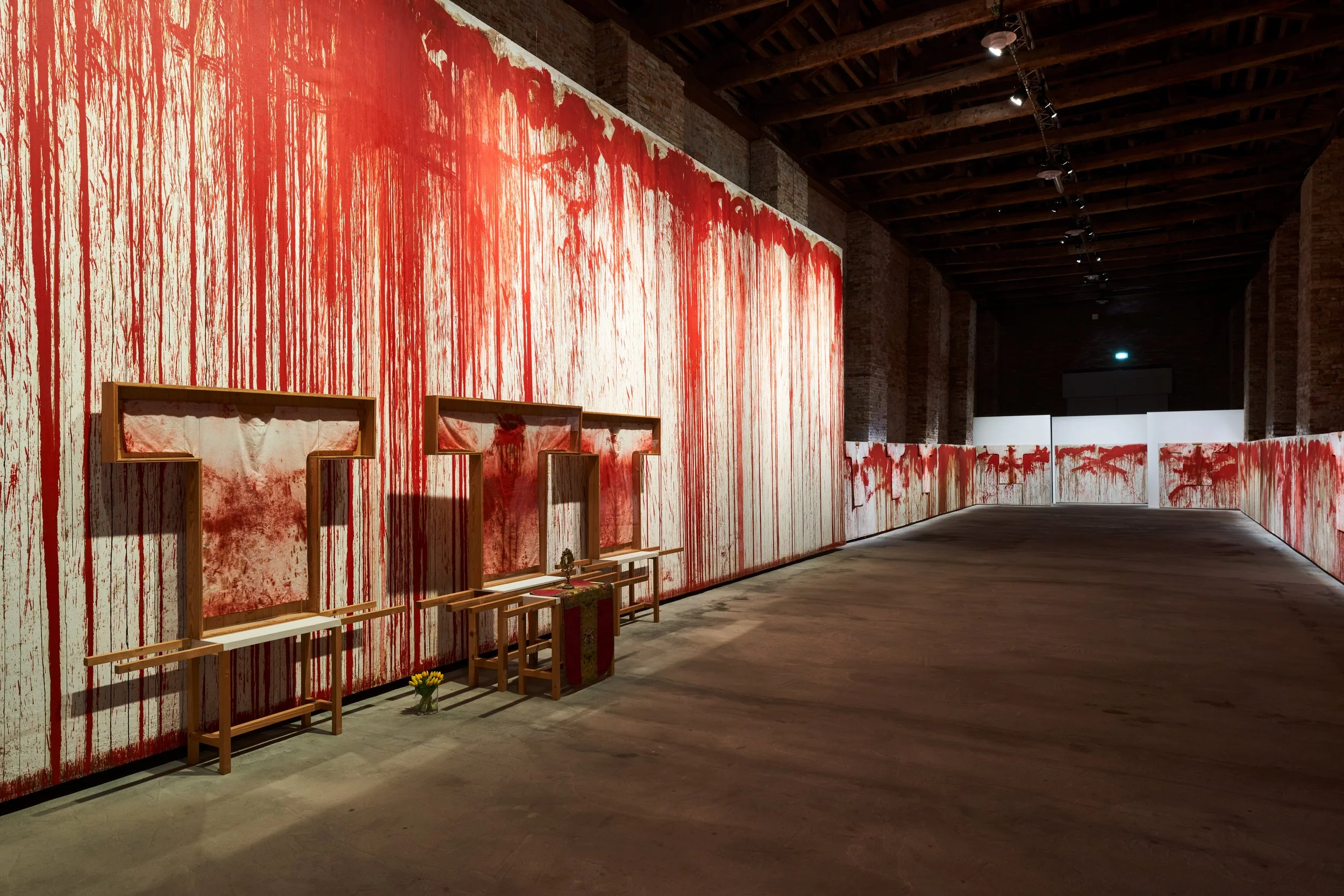
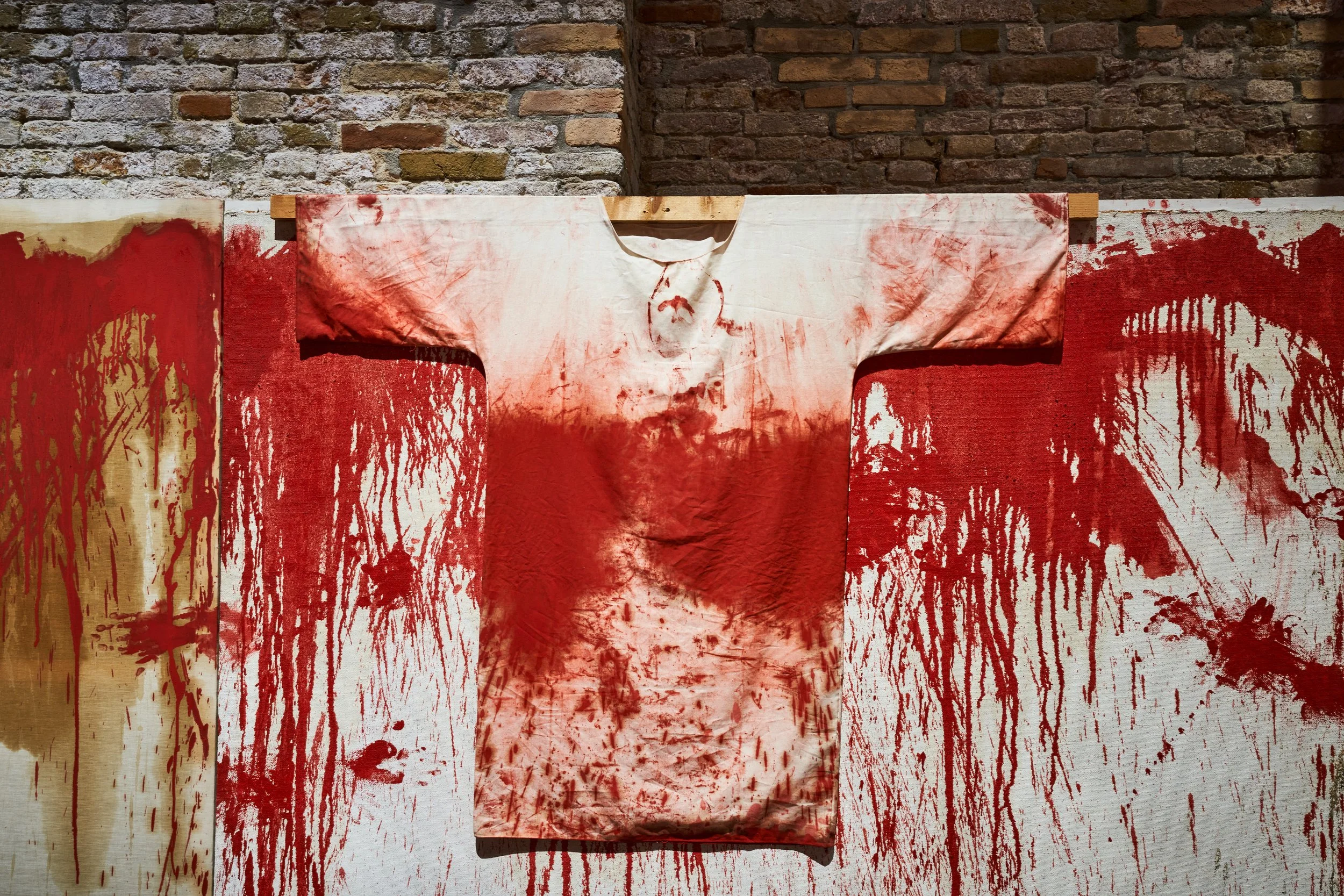
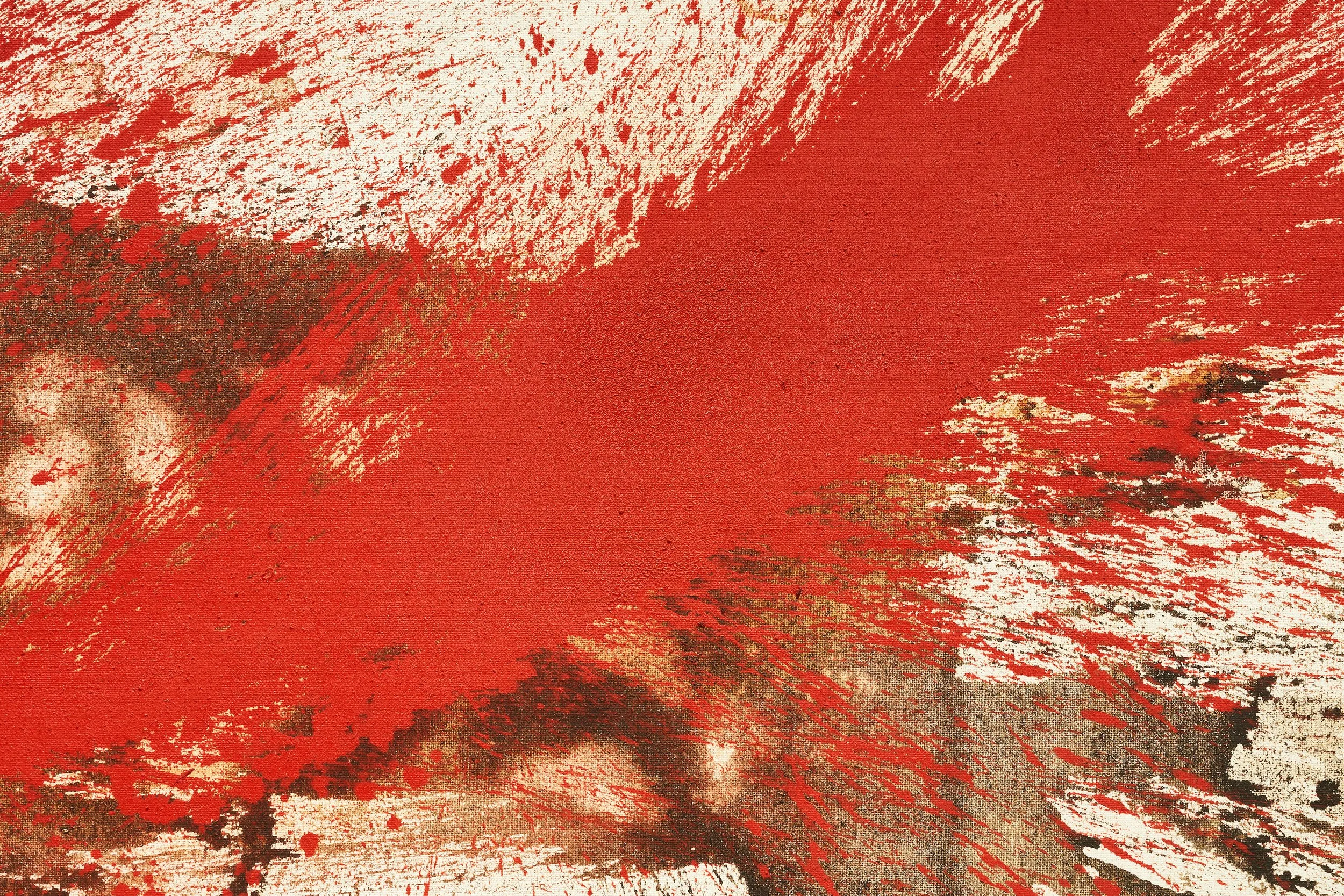
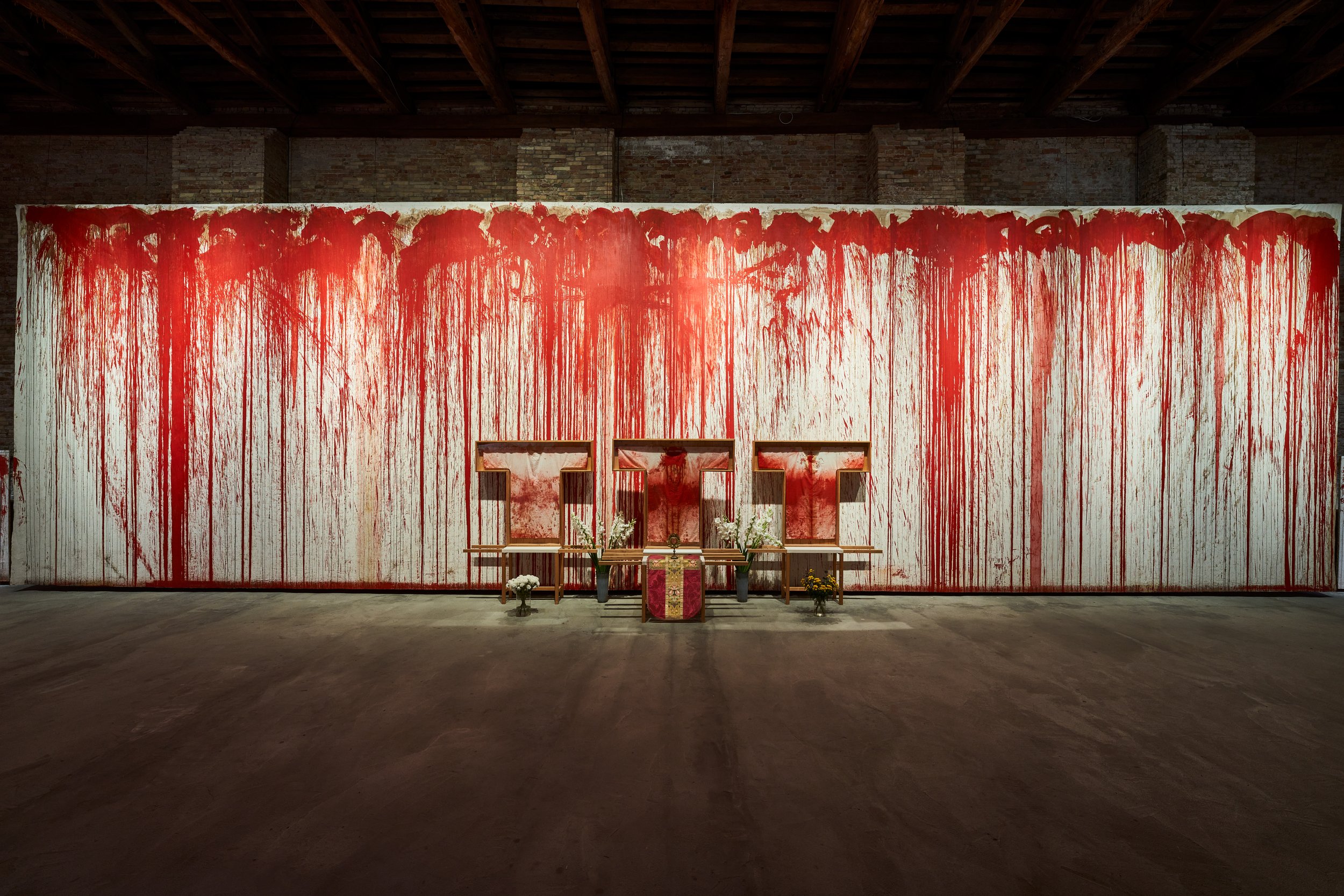
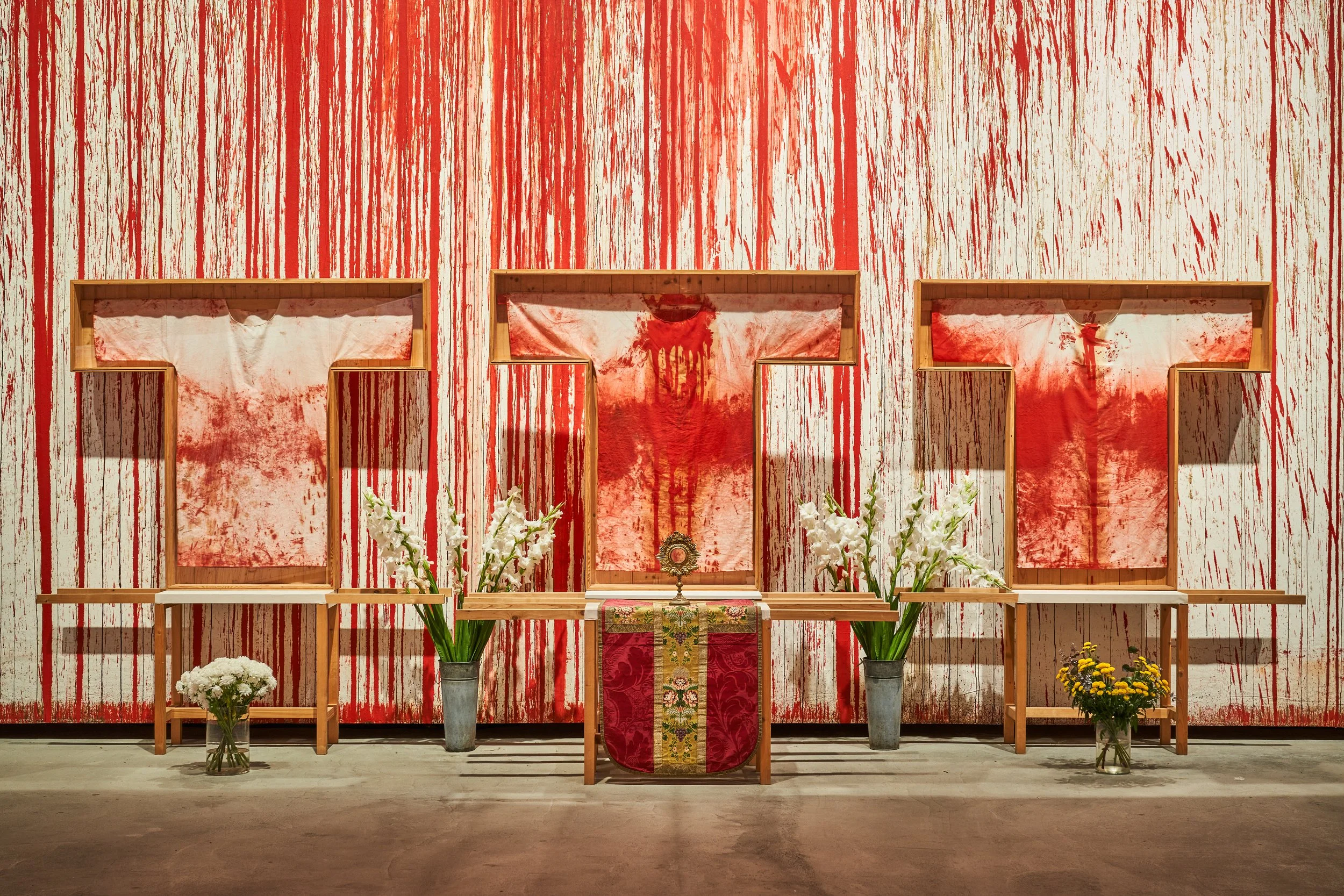
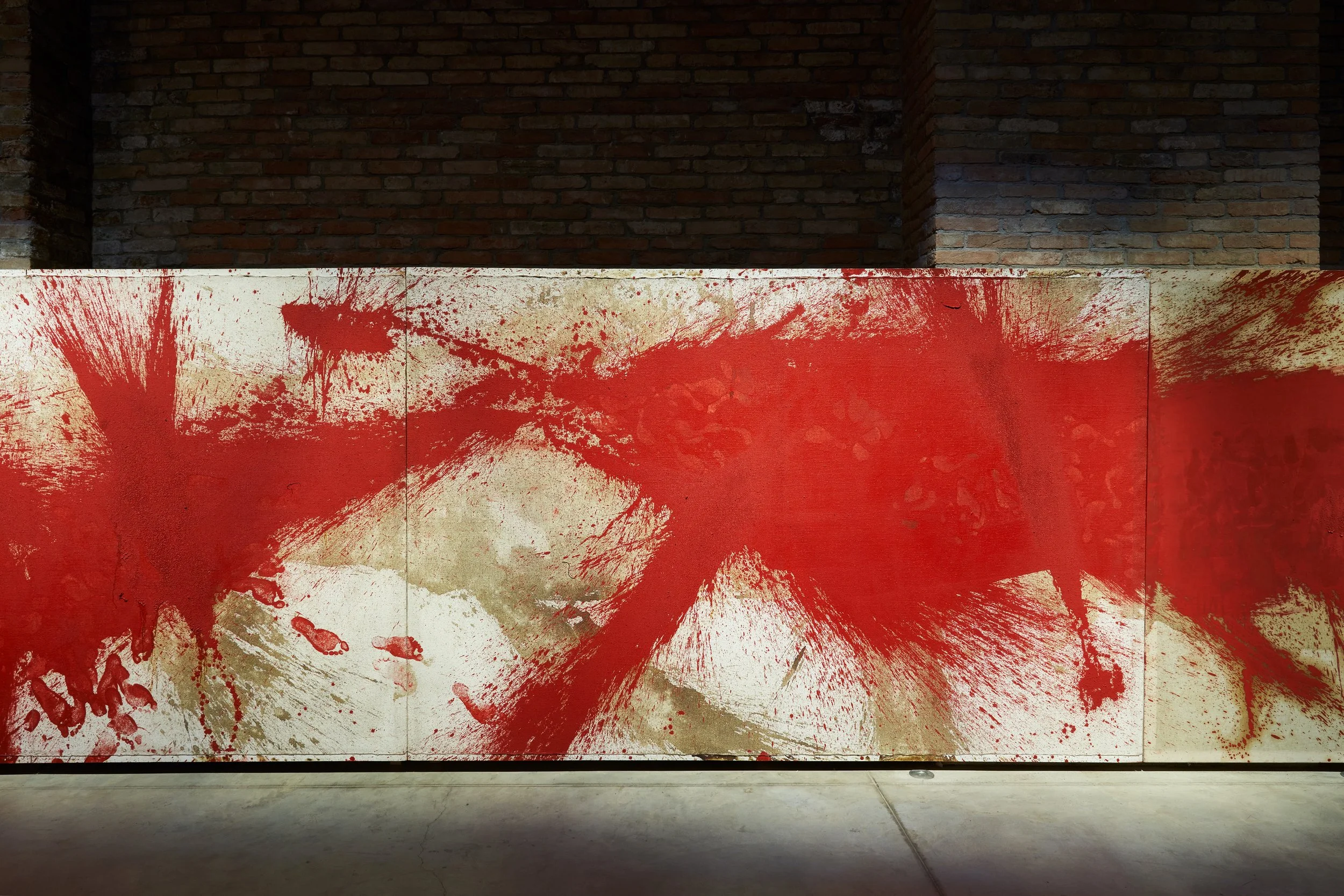

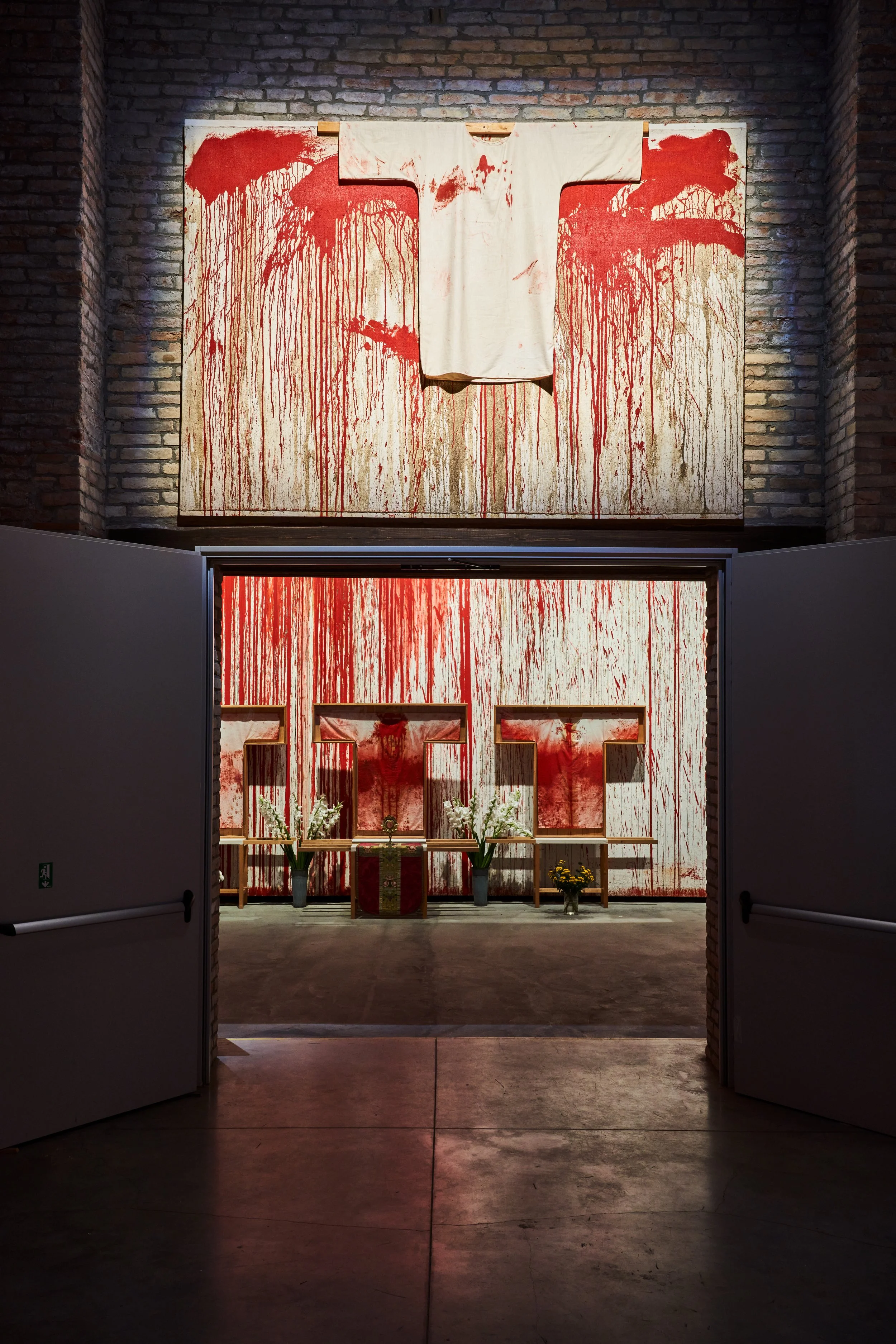

This painting action takes on a special role in Nitsch’s oeuvre, as it was performed and exhibited at the Vienna Secession. We are very pleased that these works remain in one hand – the Helmut Essl’s private collection.
The works of the 20th painting action in the Wiener Secession reveal impressively their genesis that took place between ‘unleashed outbreaks of fury and delicate gestures’. We are immersed in a pictorial, actionist environment in which the basic constants of his work spread out visually, located between the momentary and the eternal, the dynamically moving and the contemplatively calm, the real and the symbolic, between purity and defilement, excessive demands and reflection.
With the large-format poured painting (5×20 m) on the front wall, and numerous smaller splatter and poured paintings flanking it, a space-filling panorama is created, illustrating like no other in condensed form the essence of Nitsch’s painting as an integral component of his ‘Orgies Mysteries Theater’ conceived in a synaesthetic manner.
Nitsch declared: “I wanted to show how the spilling, squirting, smearing, and splashing of red-coloured liquid can evoke a sensorily intense arousal in the viewer, inviting sensorily intense sensations.” As part of his comprehensively conceived ‘Orgies Mysteries Theater’, the painting action is intended to trigger in the public a heightened experience of sensory reality, ideally leading to reflection on one’s own existence.
The renewed integration of the works from the 20th painting action in the historical space of the Oficine 800 on the island of Giudecca not only enables a recapitulation of his most important works; it also allows Nitsch’s artistic ideas located between the ecstatic and the contemplative to be re-traced and re-experienced.