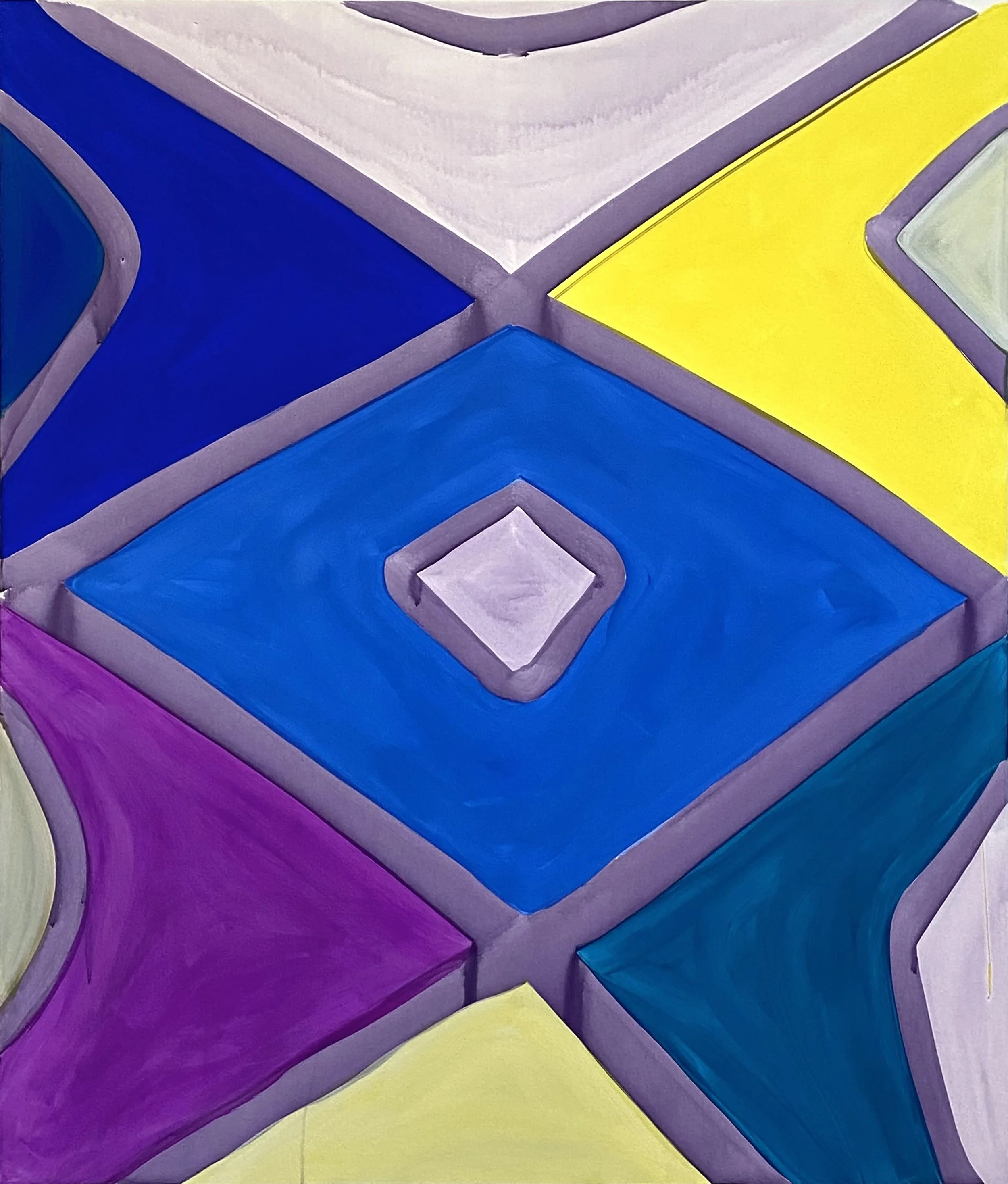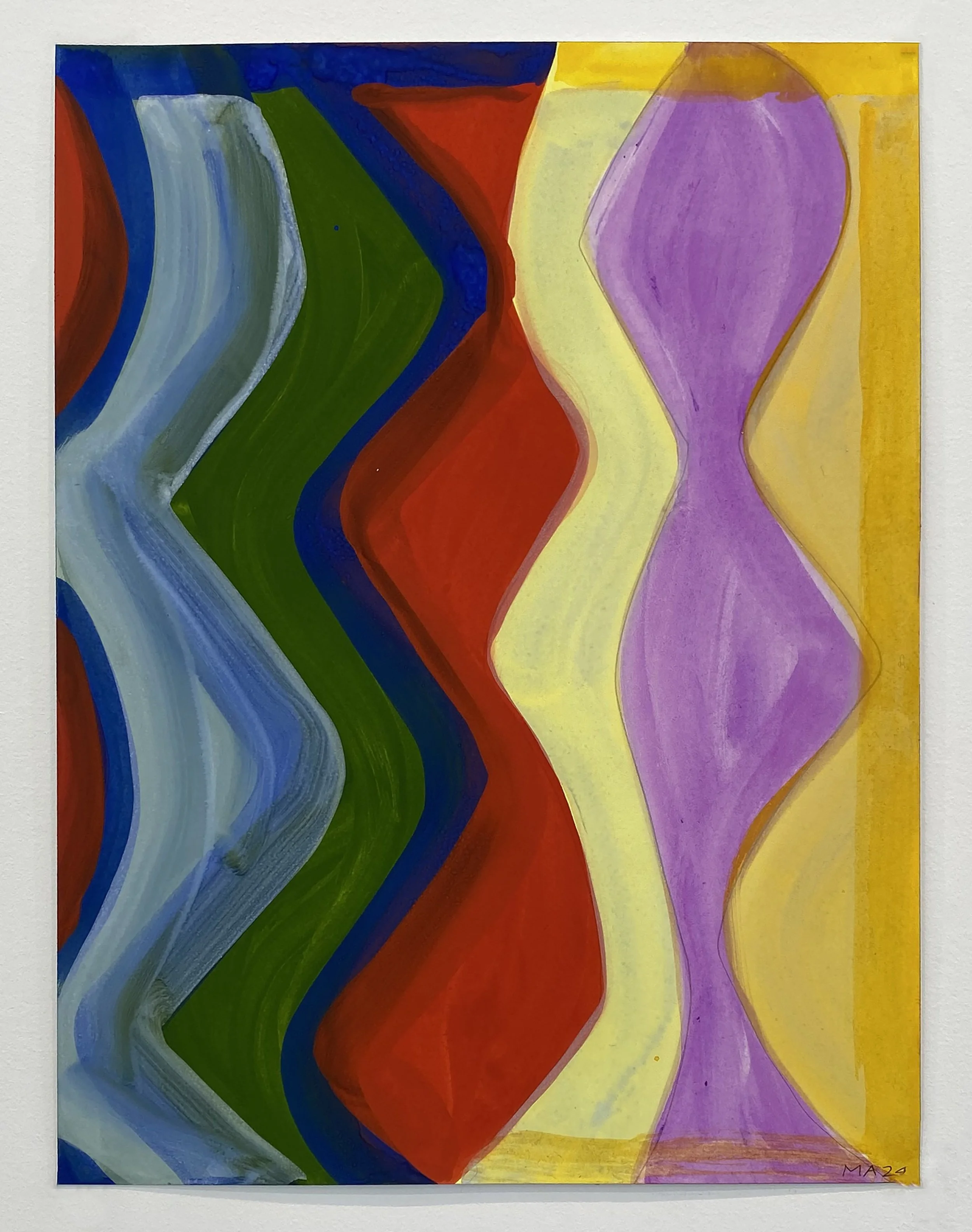
There is a sense of movement in Marina Adams’s paintings that feels almost impossible to hold still. Colour pushes against colour, forms meet and sep- arate, patterns unfold like rhythms, and the eye is invited to wander rather than arrive. For more than four decades, Adams has developed a language that resists the easy distinction between abstraction and reality, drawing freely from painting, poetry, music, textiles and visual traditions that cross cultures and centuries. Hers is a practice built as much on looking as on living—on beauty without apology, slowness as attention, and the belief that a painting ultimately finds its meaning in the private encounter between the work and the person standing before it. We spoke with Marina Adams about rhythm, edges, Italy, po- etry, beauty, and what remains real in painting.
Art Talk Magazine: You have said that you are uncomfortable with the word abstraction be- cause it suggests taking something real and ab- stracting it, whereas the things you deal with in painting are themselves very real. After more than four decades of painting, what is real to you in a painting today?
Marina Adams: What is real to me is the energy in it, the intelligence of it, the sense of life in it, the rhythm and the relationships between one thing and another.
ATM: Your paintings can appear extraordinarily free—forms bend, touch, separate and almost dance across the canvas—yet underneath that freedom there is a remarkable sense of structure. At what point does intuition become composi- tion, and how do you know when freedom in a painting has found its form?
MA: With composition, the work generates new work. I start somewhere, and that takes me some- where else. But I don’t think there is a prescription for when intuition becomes composition. You keep responding. You shift something, cover something, open something up. And eventually the painting tells you that it has arrived. You just have to listen.
ATM: You have described pattern as a language capable of crossing boundaries and creating common ground. At a moment when the world seems increasingly determined to emphasize difference, can pattern—and perhaps painting itself—still offer a place in which we recognize what we share?
MA: I think it can. I believe that if you can make someone feel good, just by looking or listening, you touch a deep part of them. This can subtly make real structural change and create a shared common ground with others. It can eliminate the boundar- ies that we have been taught that separate us.
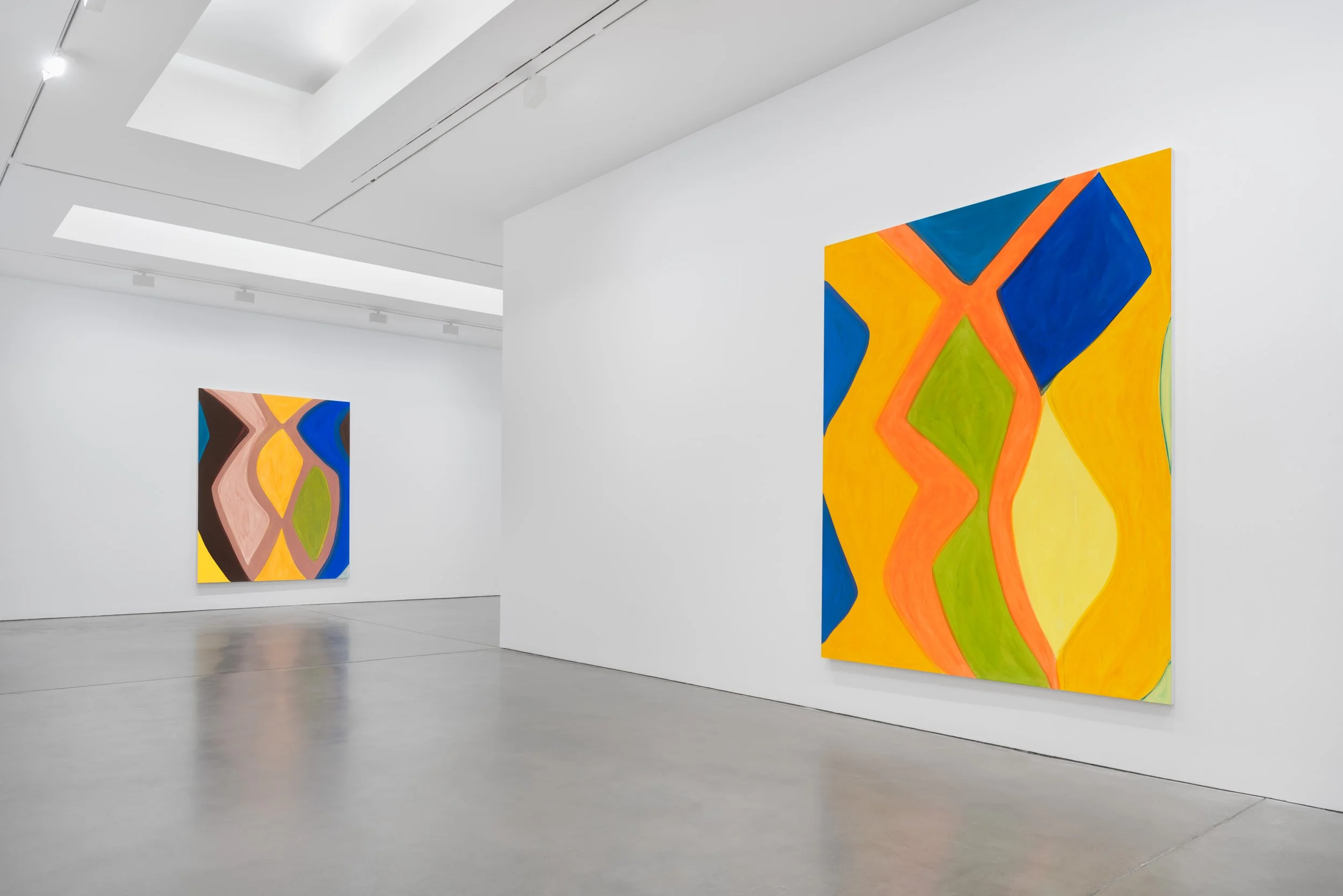
ATM: Your sources range extraordinarily wide- ly—from North African textiles, Moorish mo- saics and Indigenous American pottery to the Great Pyramids, Matisse and Hilma af Klint. How do you absorb such different visual histo- ries without allowing reference to become quotation? MA: I have always felt that one’s work is a combi- nation of all the things one loves, as well as all the things one has witnessed and found important. I’m not trying to replicate my influences. Things stay with you and get absorbed and that informs your work in many different ways.
ATM: Colour in your paintings never feels simply applied to a form; it seems to create the form. One colour pushes another forward, an- other recedes, and suddenly the painting begins to move. Do you experience colour primarily as something visual, or has it become something closer to a physical sensation?
MA: Both, I don’t separate the two.
ATM: Music runs deeply through your work— from Mambo to Billie Holiday, Nina Simone and the musical references embedded in your titles. You have said that rhythm is fundamen- tal not only to art but to life itself. When you paint, are you composing something closer to an image, or something closer to music?
MA: Rahsaan Roland Kirk (the musician, genius and educator) speaking on one of his albums about the music, he said “splitting the mind in two parts... One part of your mind says ‘Ooo bla dee’ and the other part of your mind says, ‘What does he mean?’.”
Music doesn’t have to tell you what it means. It can move you physically. Painting can do that too.
ATM: Poetry has accompanied your practice for decades, through your collaborations with Norma Cole, Vincent Katz, Leslie Scalapino, Christian Prigent and others. A poet can create enormous space with very few words. Has poet- ry taught you that a painter can do the same— that reduction can actually make a painting larger?
MA: Great painting has taught me this and great poetry has affirmed it.
ATM: You have spoken beautifully about Cézanne and his ability to “find an edge”—and about how that question enters your own think- ing about seeing. What happens at the edge between two forms in your paintings? Is that boundary perhaps where the painting actually begins?
MA: The edge is not simply a boundary, it is a place of transition. It is a place where things can shift and change.
ATM: You divide your life between New York and Italy, and for decades you have spent sum- mers in the hills outside Parma making inti- mate works on paper that eventually return with you to New York. What does Italy allow you to see—or perhaps allow you to stop see- ing—that New York does not?
MA: The summers in Italy became a way of build- ing another type of time into my practice. I could work, mostly on paper and explore things without having to know where they were going. I could
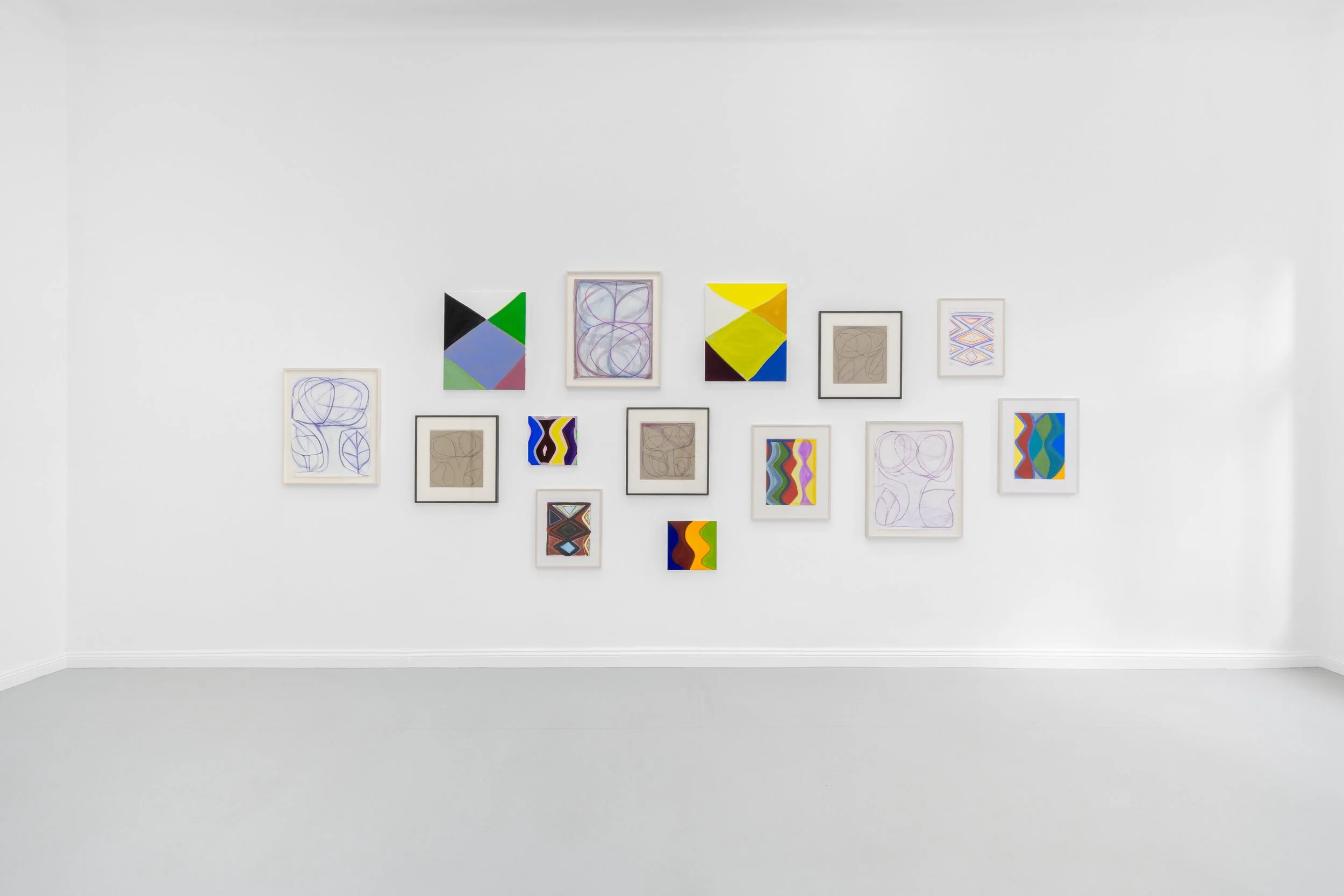
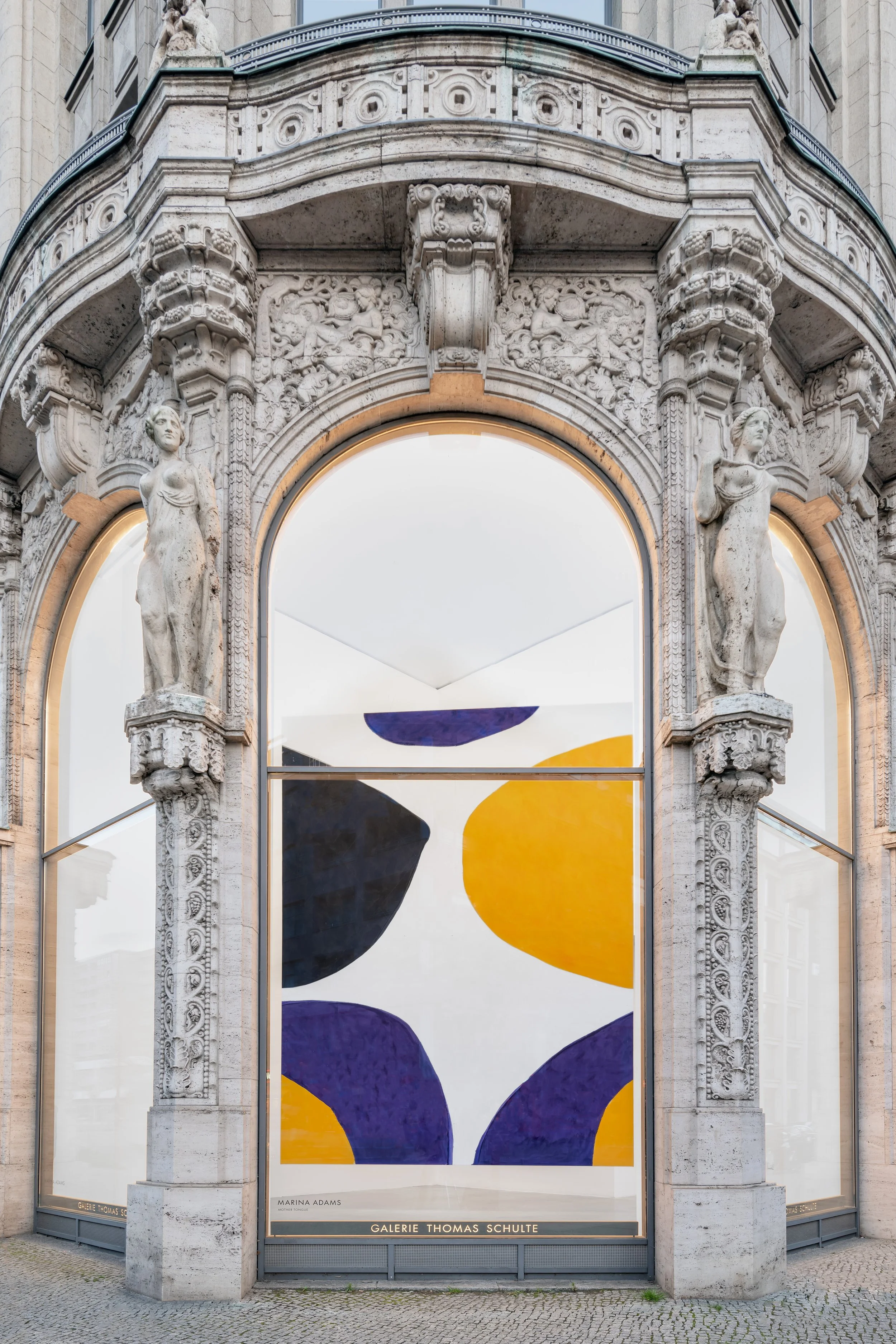
The Art of Living Slowly, Installation view at Galerie Thomas Schulte, Berlin, 2025 Photo by GRAYSC, Courtesy of the artist and Galerie Thomas Schulte, Berlin
ATM: Your 2025 Berlin exhibition was called The Art of Living Slowly. That title feels almost radical in a culture built around acceleration, production and constant visibility. Has slowness become not simply a way of working for you, but a form of resistance?
MA: We live in a world where technology is con- stantly asking for our attention. A painting can ask you to stay. To stop, look and listen.
ATM: Your career is particularly interesting because recognition did not arrive through the mythology of the very young artist suddenly discovered by the market. You developed your language over decades before receiving consid- erably greater institutional attention. Did that long period outside the centre of the art world’s attention ultimately give you something that ear- ly success might have taken away?
MA: It’s not that I didn’t want opportunity and ex- posure, but I was more interested in seeing where the work led me. And it took time for me to see that my trajectory is more of a spiral than a straight line. In a spiral, you keep coming back around, but everything has shifted, allowing you to see differ- ently each time and gain clarity from that.
ATM: There has historically been a suspicion within Western art criticism toward beauty, ornament, pattern and decoration—particu- larly when these intersect with textiles or tra- ditions historically associated with women and non-Western cultures. Your paintings embrace all of them without apology. Do you see beauty as something painting needs to defend, or is the more radical gesture simply to stop defending it? MA: I do believe that in western culture, the intel- lect in beauty, ornament and pattern isn’t under- stood or trusted, which is why I strongly embrace them in my work. In my exhibition, Cosmic Repair, I titled a painting after a line from the American philosopher Ralph Waldo Emerson’s poem, The Rhodora, “Beauty is its own excuse for being”. I think that says it all.
ATM: Your recent exhibition Cosmic Repair emerged against a background of environmen- tal, humanitarian and political upheaval, yet the paintings remain intensely alive with colour. You have spoken about joy existing without denying what is happening around us. Can making some- thing beautiful in a difficult moment become an act of resistance?
MA: Yes. I think it can. This is a dark time, and we need to see our way out of it. Not to deny what is happening, but to make something that might give people another way of seeing what is possible.
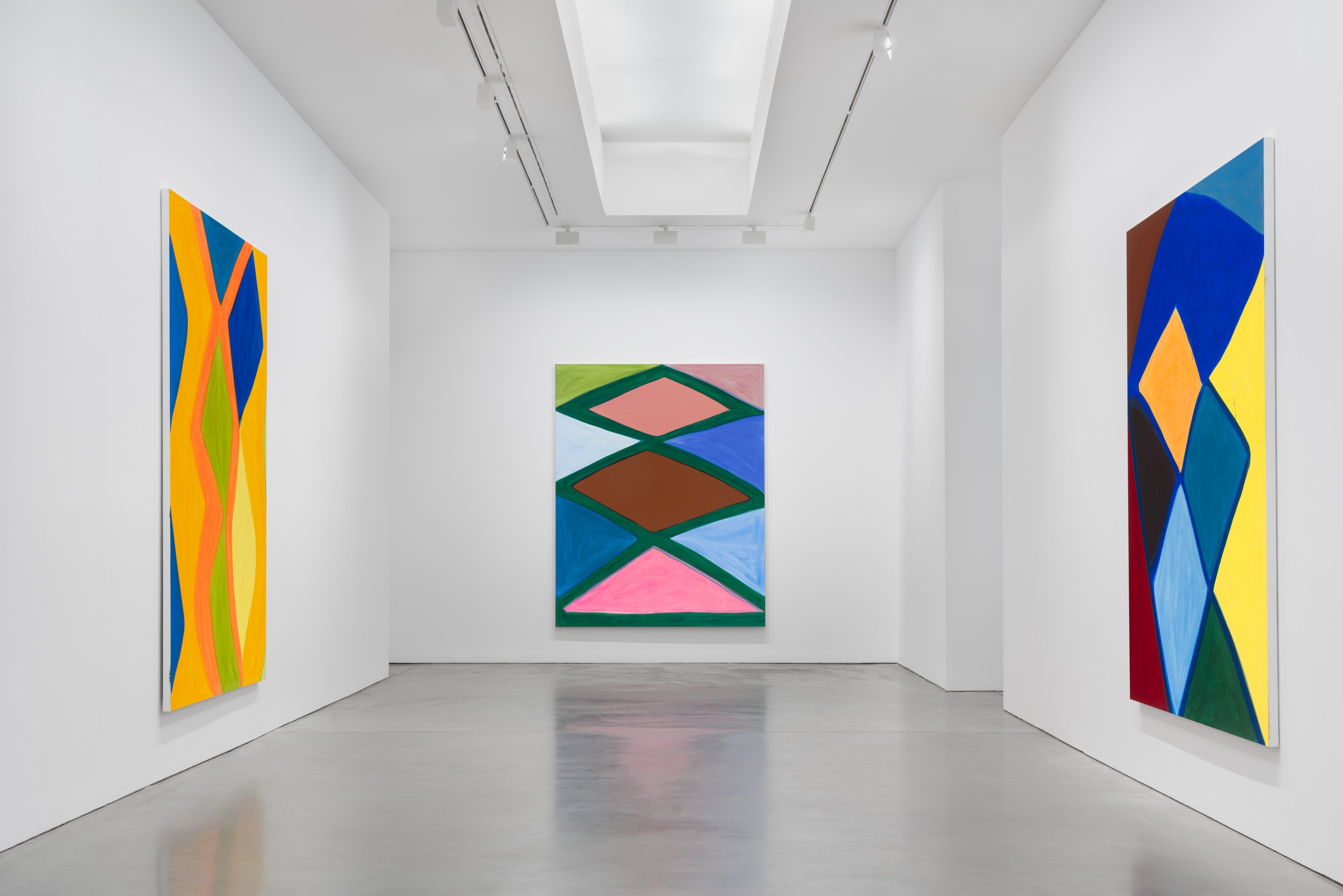
ATM: Your 2026 survey of works on paper reach- es back to 1994, allowing more than thirty years of your thinking to coexist in a single exhibition. When you encounter the artist you were thirty years ago, do you recognize the same questions or do you sometimes feel that you are looking at the work of somebody else?
MA: It’s me, just a young me. Time and practice allow you to develop what it is you want to say with more clarity, more ease. Experience also gives you the sails to weather the storms. The Work on Paper survey offered me a look at a fierceness in my early work that one must have when young and without much support. It is a matter of artistic survival.
ATM: You once described art as something that is ultimately about being lived with. If we remove museums, markets, criticism, art history and even the idea of career from the equation, what do you ultimately hope happens between one of your paintings and the person standing alone in front of it?
MA: I think the work should give you space. Space to think, space to dream, space to feel something that you can’t necessarily put into words. The paint- ing doesn’t have to give you an answer, maybe just the confidence of knowing something that you can’t explain.